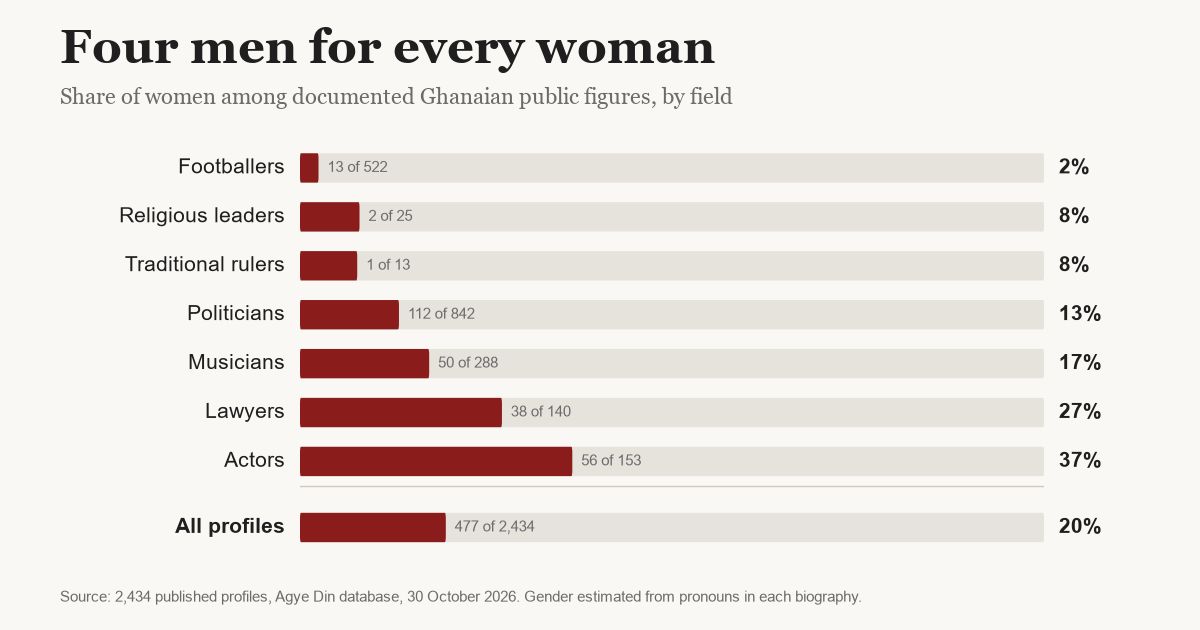
Agye Din, a database that catalogues 2,434 Ghanaian public figures, shows that of the 842 politicians with published biographies, only 112 are women. In the 522 footballers recorded, a mere 13 are female.
The figures, drawn from MPs, judges, musicians, pastors, chiefs and Premier League players, highlight a persistent gender imbalance across almost every sector. Women account for just 12% of all profiles, a ratio that mirrors the male‑dominated composition of Parliament, which, as of January 2025, has no members born after 1993.
Disparities are most pronounced in religious and traditional leadership, where of 25 religious leaders only two are women, and of 13 traditional rulers only one is female. Among lawyers the gap narrows to 27%, and among actors to 37%. Only in niche categories such as TV presenters, authors and scientists do women approach parity.
The football data, added en masse in October 2026, reflects the comprehensive coverage of the men’s Premier League. The women’s game, by contrast, receives far less documentation; the Black Maidens’ 2026 U‑17 World Cup run is noted, but player profiles remain scarce.
Geographical representation is uneven, with Greater Accra housing 35% of profiles despite comprising only 17.7% of the population. The northern regions, home to 19% of Ghanaians, account for just 12.5% of profiles.
Age also skews the record: only 84 individuals born before 1940 are listed, while 363 born after 2000—mostly young athletes and musicians—dominate the database.
The gaps stem from the database’s reliance on published sources. Women who have led local associations or northern chiefs who have never been interviewed by national media remain undocumented, perpetuating a cycle of invisibility.
Addressing the imbalance requires upstream changes: regional newsrooms, women’s sports coverage, and broader documentation of local leaders. Until then, Ghana’s written public record remains a ledger of men, four times out of five.