Ghana has enacted the Cybersecurity Act, 2020 (Act 1038), which criminalises key forms of online child sexual exploitation, and established a National Child Online Protection Framework. The Cyber Security Authority’s Safer Digital Ghana campaign, UNICEF Ghana, CHRAJ, the Data Protection Commission, the Ghana Police Service, schools, technology companies and civil‑society groups such as Child Online Africa all contribute to a growing protective ecosystem.
Yet the real test is whether these efforts are connected, measurable and fast enough to respond to grooming, blackmail and other abuses that can start in a chat or a game thousands of kilometres away. A child can be groomed even if he or she understands the danger; a parent may recognise cyberbullying but not know where to turn when blackmail occurs; a teacher may spot abuse yet lack a clear reporting protocol; a police officer may receive a complaint without the specialised digital‑forensic capacity to investigate it.
What Ghana needs is a complete protection chain: prevention, detection, reporting, response, investigation, prosecution and recovery. The system must work from the moment a child reports abuse to the point where the perpetrator is identified, prosecuted and the child receives psychological and social support. Without data on how many reports are received, how quickly they are assessed, how many lead to investigations and how many cases reach prosecution, activity is measured, not impact.
Experts argue that a single connected National Child Online Protection System is essential. It would link existing institutions through clear referral pathways, shared accountability and consistent response standards. Reporting channels must be child‑friendly and accessible to children with disabilities, and common expectations for response times, evidence preservation, confidentiality and follow‑up must apply regardless of where a child lives or which institution first receives the complaint.
Parents need practical digital‑parenting tools rather than surveillance lectures. Schools must adopt digital safeguarding policies, train teachers to recognise online exploitation and preserve evidence, and embed digital literacy into the curriculum. Technology companies must design child safety into their products with effective reporting mechanisms, age‑appropriate defaults and systems that detect and respond to child sexual exploitation material.
Investigators, prosecutors and the judiciary require specialised training in digital evidence, social media, cryptocurrency and cross‑border cooperation. Children themselves must be partners in policy design, ensuring the system reaches every child, including those with disabilities and those in disadvantaged communities.
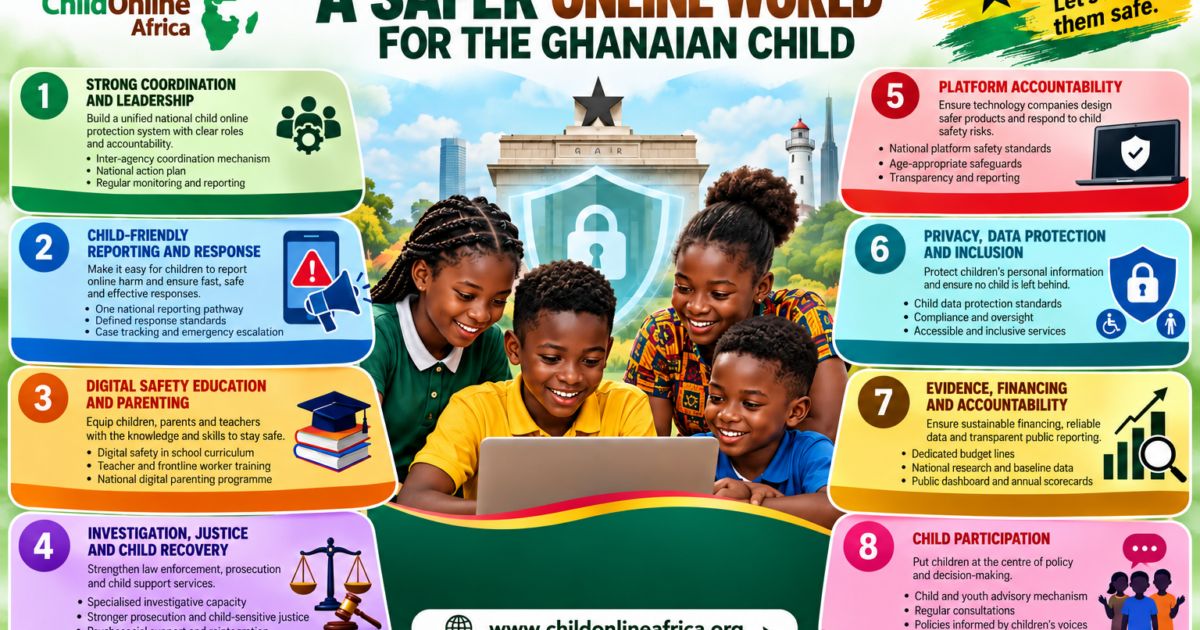
In a practical 12‑month agenda, Ghana could focus on eight priorities with clear institutional owners, measurable outcomes and timelines. Short‑term projects and occasional campaigns will not suffice if the underlying system remains fragmented.
As Ghana continues to build its digital safety framework, the question remains: will the country’s foundations evolve into a fully connected protection chain that can keep pace with the sophisticated threats children face online?