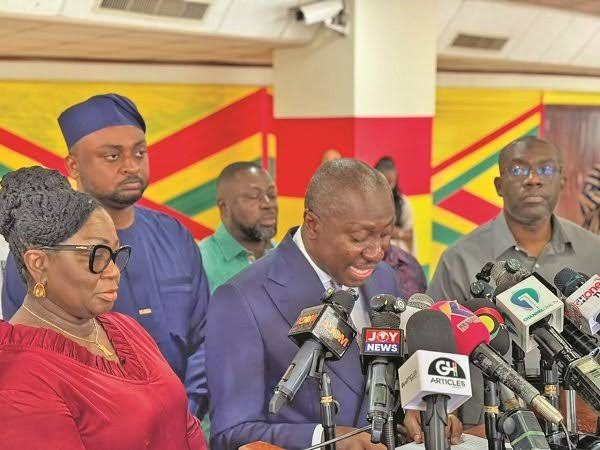
The Minority Caucus in Parliament has called on the Ghana Gold Board (GoldBod) to account to Ghanaians for how it incurred $1.7 billion, the equivalent of about GH¢22 billion, in losses from its gold trading operations in 2025.
The Caucus said an International Monetary Fund (IMF) report on Ghana's Domestic Gold Purchase Programme (DGPP) found that the Bank of Ghana (BoG) accumulated gold and intermediated foreign exchange to the private sector in a process that left the state absorbing the $1.7 billion in underrecoveries.
Addressing a press conference at Parliament House in Accra on Tuesday, Minority Leader Alexander Afenyo-Markin said the loss amounted to roughly 1.5 per cent of Ghana's gross domestic product. He said the figures came from the IMF's sixth and final review of Ghana's Extended Credit Facility programme, completed on July 10, which examined the financial consequences of the National Democratic Congress government's domestic gold purchase programme.
Afenyo-Markin said government had already accepted the IMF's findings and was acting on the concerns raised, and warned that if GoldBod failed to heed the advice, accountability would eventually catch up with those responsible once the current administration leaves office.
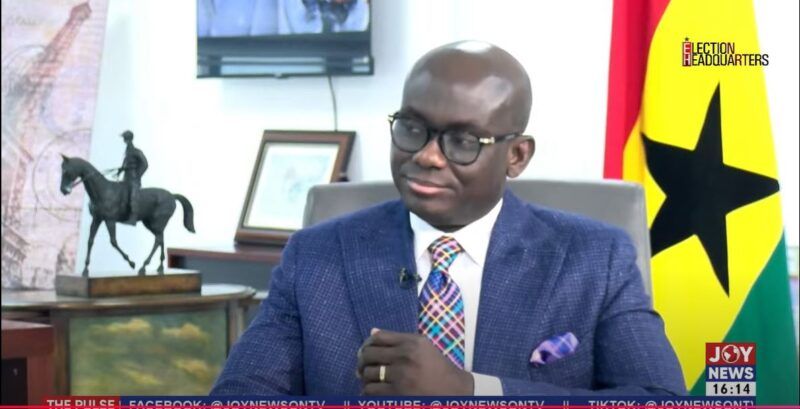
Responding to the allegations, GoldBod Chief Executive Officer Sammy Gyamfi rejected the claims outright, describing them as persistent falsehoods with no basis in fact. He said the Ghana Gold Board's audited annual report and financial statements for the year ended December 31, 2025 showed an operational surplus of GH¢907 million and an overall surplus of GH¢5.4 billion, figures he noted were prepared and published by the Auditor-General. He said he would respond further to the claims at the Government Accountability Series.
Afenyo-Markin argued that even if GoldBod was technically purchasing gold on behalf of the central bank, that arrangement did not remove its operational responsibility, since an agent handling billions of cedis in public resources remains accountable for how well it executes that role. He said GoldBod's own description of its mandate shows it holds exclusive authority over buying, selling, weighing, grading, assaying, valuing and exporting gold, placing it at the centre of the country's gold trading structure.
He said GoldBod needed to disclose what prices it paid for gold, how those prices were set, what premiums, if any, were paid to secure supply, how international buyers were selected, at what discounts doré gold was sold, and how much the agency earned in service and assay charges from transactions financed by the central bank. He also asked what commercial risk GoldBod itself bore against what was automatically passed on to the Bank of Ghana, and what internal controls existed to protect the central bank as financier. "If GoldBod controlled a critical part of the trading process but BoG absorbed the losses, where precisely did commercial accountability reside," he asked, arguing that a model in which one entity earns fees while another absorbs losses needs scrutiny, since rising transaction volumes could boost GoldBod's revenue even as the wider programme lost value overall.
On the Auditor-General's surplus finding, Afenyo-Markin argued that the audit may not have captured the full picture, saying that if the Auditor-General had known the true costs of GoldBod's transactions were being borne by the central bank, a surplus would not have been declared in each reporting period. He said GoldBod could not claim credit for revenue from fees while pushing every loss onto the central bank's books, adding that this dynamic was behind the Bank of Ghana's decision to halt its gold purchasing operations going forward.
He said the losses generated by GoldBod's purchasing, pricing and sales decisions could no longer sit solely on the central bank's balance sheet while GoldBod retained the credit, describing the arrangement as an accounting structure that looks clean on the surface but is troubling underneath. He challenged GoldBod to disclose who its off-takers are, why sales were discounted, and why a mandate to trade gold on the country's behalf had produced losses the public was never informed about.
On the wider fallout, Afenyo-Markin said the IMF's figures show the Bank of Ghana's equity stood at negative GH¢93.8 billion at the end of last year, equivalent to negative 6.7 per cent of GDP. He described the central bank as technically bankrupt, saying GoldBod's gold operations were the single biggest driver of that position in 2025. "These losses are not bad luck, as you do not trade in gold and make losses, and they expose crass incompetence in GoldBod's management and a misaligned government policy," he said.