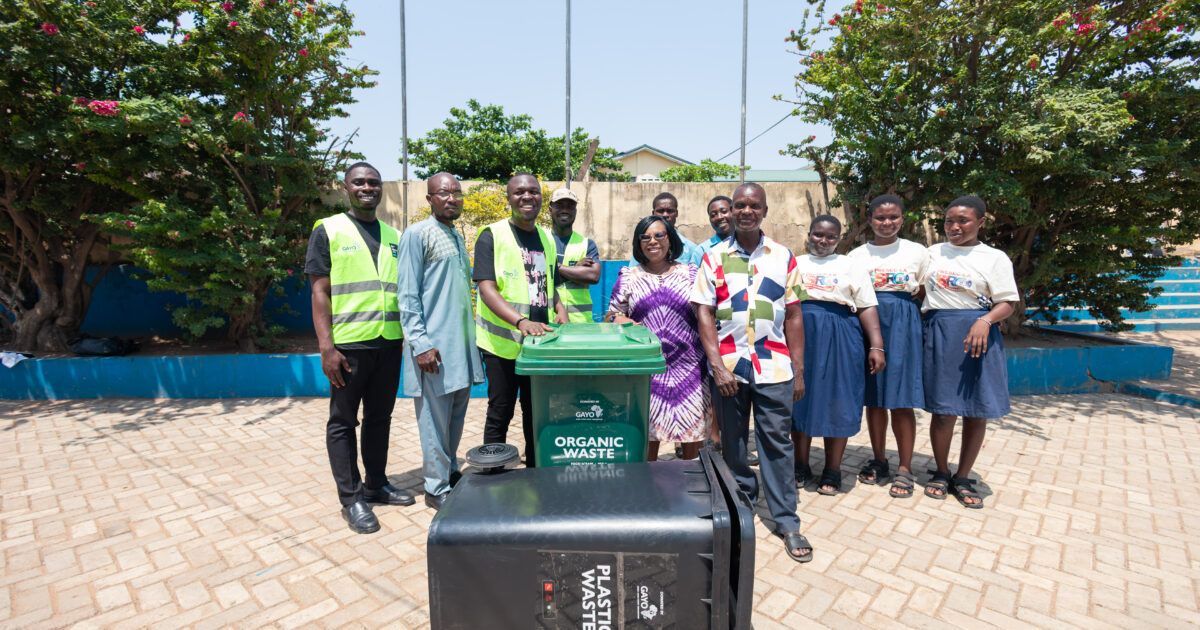
The Green Africa Youth Organization (GAYO) has teamed up with metropolitan, municipal and district assemblies and schools in Greater Accra to roll out a waste‑segregation programme under its Zero Waste portfolio.
The initiative covers schools in seven municipalities, including La Dade Kotopon, Ledzokuku, Accra Metropolitan and Ablekuma West, and aims to help schools separate waste at the source, turn organic waste into compost and recycle plastics.
Betty Adjei, Operations and Programs Director at GAYO, said the partnership comes ahead of a government directive that will require all households to begin separating their waste next year. “When is the important time to support with infrastructure, to support this kind of policy?” she asked. “It’s very important to catch them young.”
GAYO will distribute 200 bins, 300 books, pens and educational flyers to schools across the seven municipalities, with each school receiving two bins to help students separate their waste. Adjei said the programme will later extend to markets and wider municipalities.
Antonio Yayrator Korkuvi, a Project Coordinator on GAYO’s Zero Waste portfolio, said about 60 percent of the financial resources given to assemblies go into managing waste. A waste analysis by GAYO found that roughly 60 percent of the waste generated in schools is organic. “We are helping these schools to be able to separate their waste,” he said. “The organic waste is turned into what is called compost.”
The compost is used in school gardens to grow vegetables free of the chemicals found in synthetic fertilisers. GAYO is also training students to make compost themselves, while plastics will go to its material recovery facility to be processed into pellets.
The partnership also tackles a problem that has frustrated schools. Madam Habiba Kotomah, Education Director for the La Dade Kotopon Municipality, said schools that sorted their waste in the past saw it mixed back together by collection trucks. She welcomed GAYO’s plan to collect the separated waste directly and pay schools a token in return. “So they will come around and pick the organic ones and pick the plastic ones,” she said. “I’m so happy my schools are going to be able to generate some form of IGF from this activity.”
Adjei said the approach builds on work already underway. The La Dade Kotopon Municipal Assembly’s material recovery facility diverts more than 50 tonnes of waste a month.
At Forces Senior High School, Assistant Headmistress (Domestic) Rosina Lawal said the school has already placed bins within reach of students and wants more. “Imagine we have bins like one student, one bin. The school, and not only the school, the whole of Ghana will also look very beautiful,” she said. She urged GAYO to keep going: “They should add more, like Oliver Twist, we want more.”
Reducing organic waste in landfills also helps cut methane, a greenhouse gas far more potent than carbon dioxide. More than half of the waste Accra produces is organic. In October 2026, officials of the Accra Metropolitan Assembly warned that Ghana risks missing its target of cutting methane emissions from the waste sector by 30 percent by 2030.