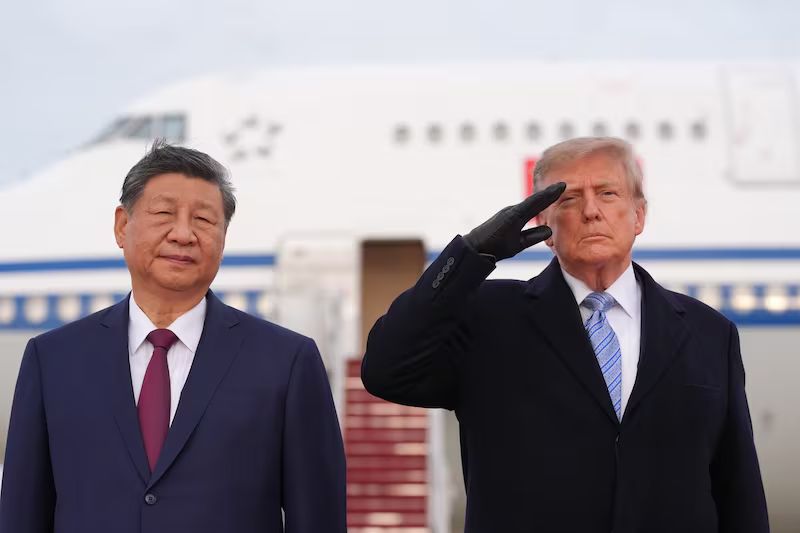
President Donald Trump met Chinese Communist Party General Secretary Xi Jinping on Wednesday evening at Joint Base Andrews in Maryland, greeting him with a 100‑foot red carpet and a U.S. Air Force band that flew two B‑1 bombers overhead. The ceremony, the first time a U.S. president has personally welcomed a foreign leader at the base since 1962, featured U.S. and Chinese flags, an honor guard, and a military fly‑over as the two leaders shook hands and posed for photographs.
Xi arrived on an Air China aircraft at 17:39 local time (22:39 BST) and was escorted by a colour guard on both sides of the carpet. The Chinese premier and his wife, Peng Liyuan, walked side by side with President Trump and First Lady Melania Trump before departing in separate vehicles to Washington. The visit, Xi’s first to Washington since 2015, is expected to include closed‑door talks, a state dinner, and discussions on AI, the Iran conflict, Taiwan, and an extended trade truce.
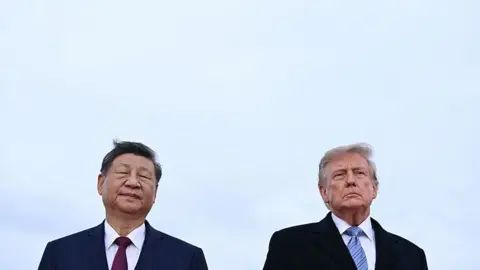
U.S. Treasury Secretary Scott Bessent announced that the U.S. and China will extend their trade truce to January, following an agreement that had expired on 10 November. Bessent, speaking after meeting Chinese Vice Premier He Lifeng, said the two sides were exploring a more substantive trade deal. Xi, accompanied by Politburo member Cai Qi, Vice Premier He Lifeng, Foreign Minister Wang Yi, and other delegates, said in a Xinhua statement that the U.S. and China are “great nations” and should be partners rather than rivals.
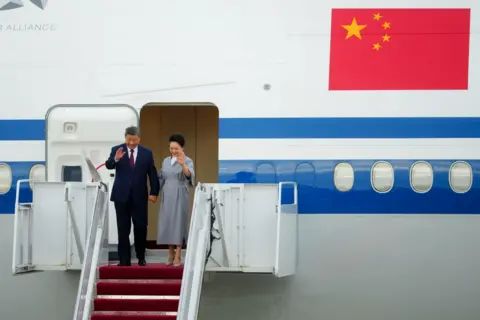
Trump dismissed warnings about the dangers of artificial intelligence as a “hoax,” and both sides are racing to dominate the sector. The summit will also feature U.S. AI company leaders at a lavish state dinner. The visit is expected to end on Friday, with the couple touring the National Archives to view records significant to U.S.–China relations.
While the U.S. has seen a slight warming in public opinion toward China—41% of Americans now see China’s territorial ambitions as a threat compared to 52% in 2022—most of Trump’s base still favors limiting relations with Beijing. The summit’s outcomes could influence future trade, technology, and geopolitical dynamics between the two powers.