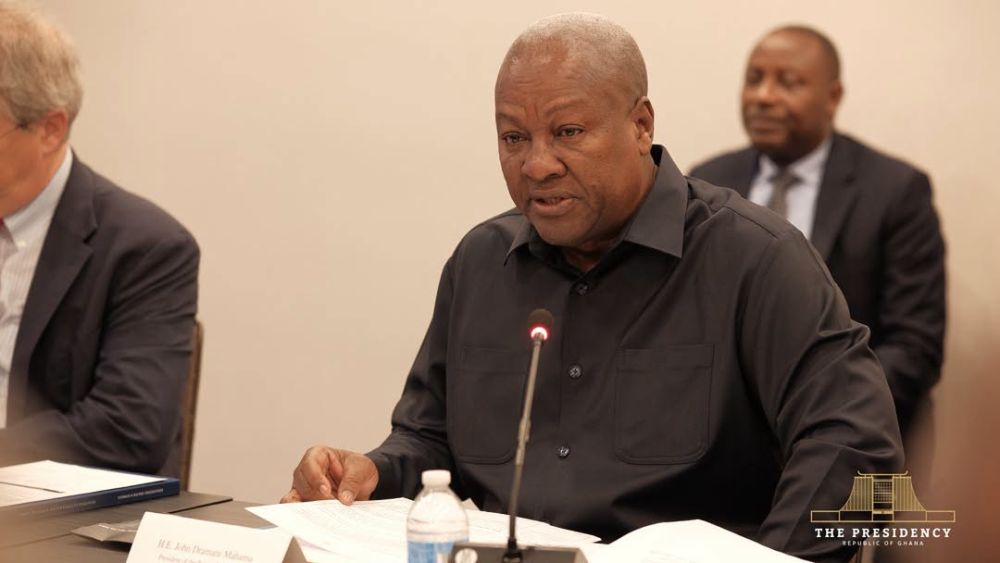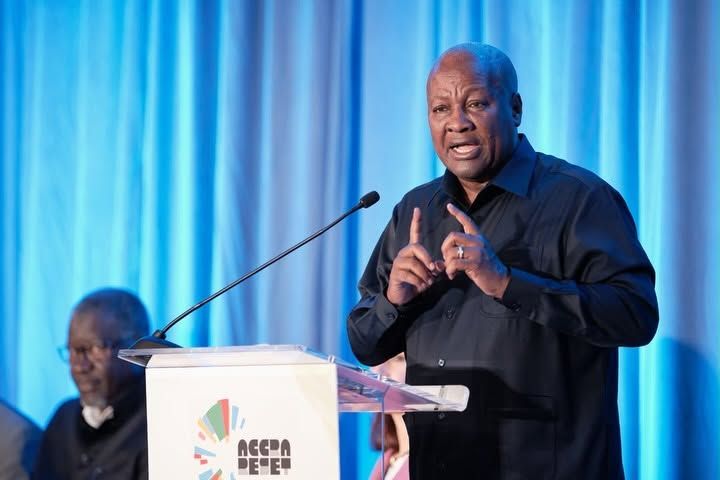
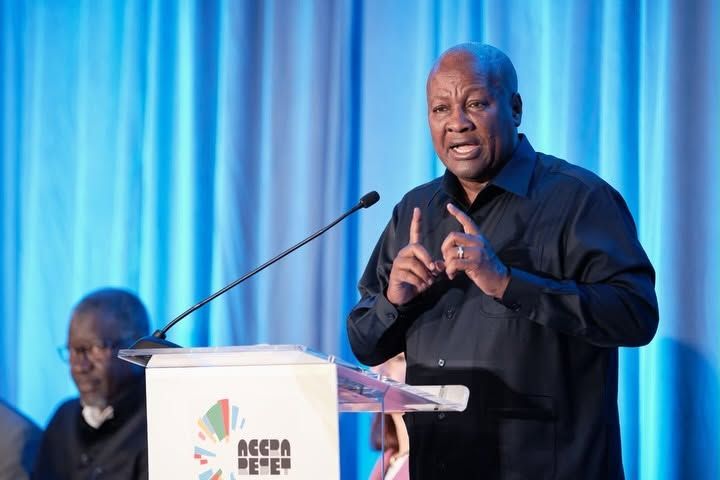
President John Dramani Mahama addressed the 81st United Nations General Assembly in New York on Monday, September 21, unveiling the High‑Level Panel Report of the Accra Reset titled “A Sovereign Future for Health.” The report calls for a restructuring of global health cooperation, insisting that countries in the Global South cannot truly own their health systems without control over financing, resources and production capacity.
Mahama argued that the current model, which keeps critical health programmes heavily dependent on external funding and decisions made outside national borders, has failed to grant meaningful ownership. “We were handed a broken cauldron and asked to own a soup cooked entirely in someone else’s kitchen,” he said in a Facebook post announcing the report. “Today, through the Accra Reset, we declare unequivocally that there can be NO ownership without control.”
The report outlines proposals for stronger national and regional capabilities, greater domestic ownership and more accountable partnerships with international development institutions. It proposes a country‑led “one‑stop” health compact, sustainable financing transitions, regional health manufacturing, improved procurement systems and independent follow‑up on commitments within six to twelve months.
Mahama highlighted that health is the first focus area, with particular attention to maternal mortality across sub‑Saharan Africa. He cited initiatives such as Mother Africa and Business United for Mothers, Babies and Youth (BUMBY) as practical interventions for women, children and young people. The Accra Reset’s Full Circle programme placed the health report at the centre of discussions on a new global development bargain, alongside initiatives on maternal and child health, skills, fair deal‑making and shared prosperity.
While advocating greater control for developing countries, Mahama stressed that sovereignty must be matched by stronger domestic accountability. He said Ghana’s reform agenda would tighten fiscal management, fight corruption and strengthen local industrial capacity, particularly in the pharmaceutical sector, to enable local manufacture of essential medicines.
The report does not call for an abrupt end to international assistance. Instead, it proposes a managed transition in which external support protects essential services while countries progressively build stronger national and regional health capabilities.
Mahama expressed gratitude to former leaders such as Nigeria’s Olusegun Obasanjo, Liberia’s Ellen Johnson Sirleaf and Costa Rica’s Laura Chinchilla, as well as the High‑Level Panel’s co‑chairs and partners, for their contributions to the initiative.
What comes next is the implementation of the Accra Reset’s recommendations, with Ghana pledging to demonstrate how sovereign health systems can be built through domestic accountability and regional cooperation.