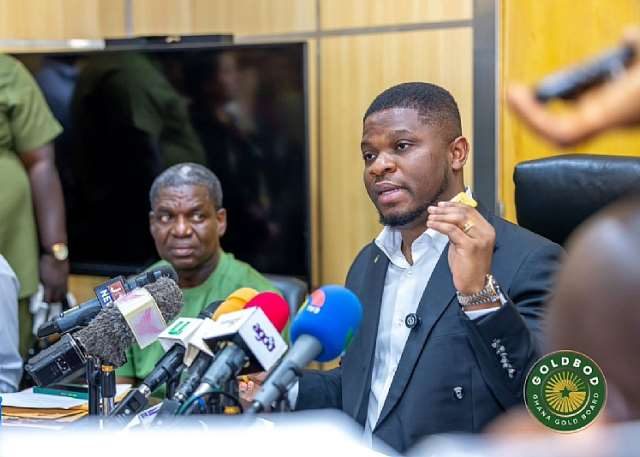
The Chief Executive Officer of the Ghana Gold Board (GoldBod), Sammy Gyamfi, has strongly rejected claims that the state owned gold buying institution incurred losses of $1.7 billion in 2025, describing the allegation as a "barefaced lie" and challenging the Minority Leader, Alexander Afenyo-Markin, to provide evidence for his assertions.
Speaking at a press briefing in Accra on Wednesday, August 19, 2026, Gyamfi accused the Minority Leader and the Minority caucus of persistently spreading falsehoods about GoldBod's financial performance on the floor of Parliament and in the media.
Gyamfi presented the audited Annual Report and Financial Statements of GoldBod for the year ended December 31, 2025, prepared and published by the Auditor-General of Ghana, as evidence of the institution's financial position. According to the report, GoldBod recorded an operational surplus of GH¢907 million and an overall surplus of GH¢5.4 billion. He explained that the operational surplus reflected revenue generated from the institution's own operations less expenditure of about GH¢109 million, while the overall surplus included GH¢4.5 billion in revolving seed capital budgeted by government in the 2025 Budget Statement as equity for the newly established GoldBod, credited to its accounts around December 30, 2025.
"Afenyo-Markin and his followers alleged on several occasions on the floor of Parliament and in the media that the Ghana Gold Board made losses in 2025. This claim is a barefaced lie which has been debunked times without number by GoldBod," Gyamfi said.
He stressed that the Auditor-General's report contained no adverse findings against the institution. "Not a single, and I repeat, not a single adverse audit finding was made by the Auditor-General in his 2025 Auditor's Report on the Gold Board, not on imaginary or hallucinatory losses, not on procurement breaches or breaches of the Public Financial Management Act," he said, describing claims that the Auditor-General lacked full access to GoldBod's operations as reflecting either a poor understanding of how an external audit works or a deliberate attempt to undermine another independent state institution. He invited the media to verify directly with the Auditor-General whether all requested documents and management letter queries were satisfactorily addressed.
On the Minority's reliance on the IMF's Country Report No. 26/213, Gyamfi argued the report had been grossly misrepresented. While the IMF found that the Bank of Ghana's Domestic Gold Purchase Programme (DGPP) incurred losses of $1.7 billion in 2025, equivalent to about 1.5 per cent of GDP, he said nowhere did the Fund attribute those losses to GoldBod. "I challenge Afenyo-Markin to point to any page, paragraph, sentence, phrase or punctuation mark in the said referenced report of the IMF where the Gold Board was accused by the IMF as the entity responsible for losses incurred by the Bank of Ghana," he said, quoting the report as attributing the loss to the scaling up of the DGPP rather than incompetence or mismanagement, and citing service and assay fees, discounts on gold sold to off takers, and exchange rate losses between forex bureau rates and cedi reference rates as the actual drivers.
Gyamfi explained that GoldBod's role under the DGPP in 2025 was a continuation of a role inherited from the defunct Precious Minerals Marketing Company (PMMC) under a Gold Purchase Agreement signed with the Bank of Ghana in September 2023, under which GoldBod served only as a buying agent with no role in selling gold, no signatory status on off take agreements and no involvement in setting prices. "PMMC, later GoldBod, fulfilled its obligations in strict accordance with the 2023 Gold Purchase Agreement and fully accounted for all advances it was given in 2025, a total of about GH¢1.33 billion," he said, arguing that since profit in commodity trading depends on selling price minus cost, GoldBod could not be blamed for losses on sales it did not control.
He also asked who was responsible for a $400 million loss the Bank of Ghana recorded in 2024, a year before GoldBod existed, when the central bank used PMMC and a private firm, Resafire, as buying agents. "If we are to accept this argument that losses under the Domestic Gold Purchase Programme are attributable to buying agents, then is Afenyo-Markin saying that buying agents in 2024 caused the loss of $400 million?" he asked.
On claims that fees paid to GoldBod contributed to the losses, Gyamfi said the assay fee of 0.258 per cent and service fee of 0.5 per cent together made up less than one per cent of the 17 per cent loss reported by the IMF, and were legitimate charges rather than "free money." He said the assay fee, approved by Parliament under the Fees and Charges Act, covers the cost of assaying services, while the 0.5 per cent service fee was the same one paid to PMMC and other Bank of Ghana aggregators from 2022 to 2025 to cover transportation, security, insurance and smelting losses.
Gyamfi concluded by challenging the Minority Leader to invite him to Parliament to answer questions on the matter. "I'm waiting with bated breath for Afenyo-Markin's invitation. I don't know why he's delaying and holding press conferences when, as Minority Leader, he can get the Public Accounts Committee to summon me tomorrow or today, and I will appear," he said, adding that he had also reached out to the new Majority Leader, James Agalga, to facilitate an invitation should the Minority Leader delay.
Addressing a press conference in Parliament a day earlier, on Tuesday, August 18, Afenyo-Markin maintained that GoldBod must account for the losses, arguing the institution could not claim credit for foreign exchange gains while distancing itself from the costs arising from the same transactions. "You do not get to keep the fees and disown the cost. This is not accounting; that is convenience," he said, warning that "post regime accountability awaits" GoldBod if it failed to heed the advice, and adding that the Minority would file a motion upon Parliament's resumption to compel GoldBod management to account for the losses.