
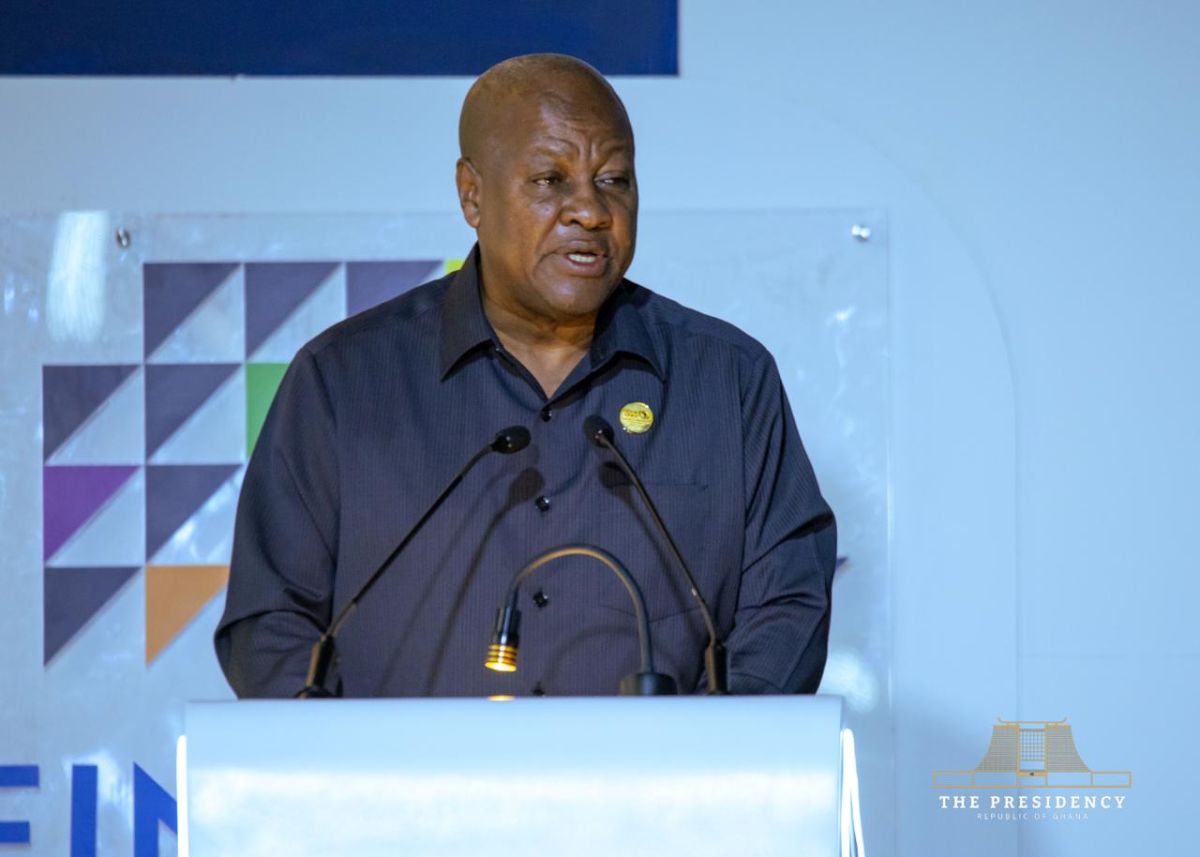
President John Dramani Mahama urged African leaders to partner with private capital, industrial developers, commercial banks and sovereign funds to establish sustainable health manufacturing and regional value chains during his keynote at the Alamein Africa Forum in Cairo, Egypt.
Mahama said governments alone cannot finance the transition to health sovereignty, noting that declining international development assistance and heavy reliance on imported pharmaceuticals and vaccines—over 70 % of drugs and nearly 99 % of vaccines—force African economies to spend billions each year abroad.
He highlighted the withdrawal of $154 million in U.S. support, of which $74 million had funded health programmes, as a recent example of the funding gap affecting Ghana’s health and education budgets.
“Governments and the private sector must work together in order that we achieve the kind of sovereignty that Africa needs in its health outcomes,” Mahama said.
Mahama cited the Africa CDC’s pooled tender for maternal and child health products, which cut prices by more than 30 % and secured 50 % of product lines for African manufacturers, as proof that coordinated demand can provide predictable markets and cash flows.
He also pointed to Egypt’s reduction of hepatitis C prevalence from about 10 % to below 0.5 % after negotiating technology transfer and building domestic production capacity, and Nigeria’s African Medical Centre of Excellence in Abuja as examples of how local manufacturing can retain specialised healthcare and curb medical tourism losses.
With Africa’s population projected to reach 2.5 billion by 2050, Mahama stressed that local pharmaceutical manufacturing would retain foreign exchange, protect economies from global supply disruptions and create jobs, especially for young Africans and trained health and science professionals.
He concluded that the African Continental Free Trade Area offers a unified market of about 1.4 billion people, enabling manufacturers to serve a continental market rather than individual national markets.
Next steps will involve drafting policies to mobilise domestic and private capital for health manufacturing and establishing regional value chains, Mahama said, urging African leaders to act swiftly before global supply chains become even more volatile.