In a recent briefing, Dr Mahamudu Bawumia and Hon. Kojo Oppong Nkrumah raised concerns about Ghana’s economic trajectory, arguing that macro‑economic stability does not automatically deliver jobs or curb unemployment. The government, however, remains confident that its new economic policy will reverse the cost‑of‑living crisis.
Publicly available data show that inflation has fallen from 23.8 % to 5.2 %, debt‑to‑GDP has eased from 61.8 % to 44.7 %, and growth sits at 6 %. Yet the Consumer Price Index for September 2026 indicates that housing, water and energy inflation sits at 10.3 %, a figure that exerts the greatest pressure on ordinary Ghanaians’ wallets.
The 2026 Mid‑Year Budget review reports a 6 % growth rate, with services expanding by 8 % and agriculture slowing to 3.9 %. Poverty has improved by three percentage points to 21.9 %, and the bank lending rate has halved to 15.6 %. Still, youth unemployment remains stubbornly high at 32.4 %.
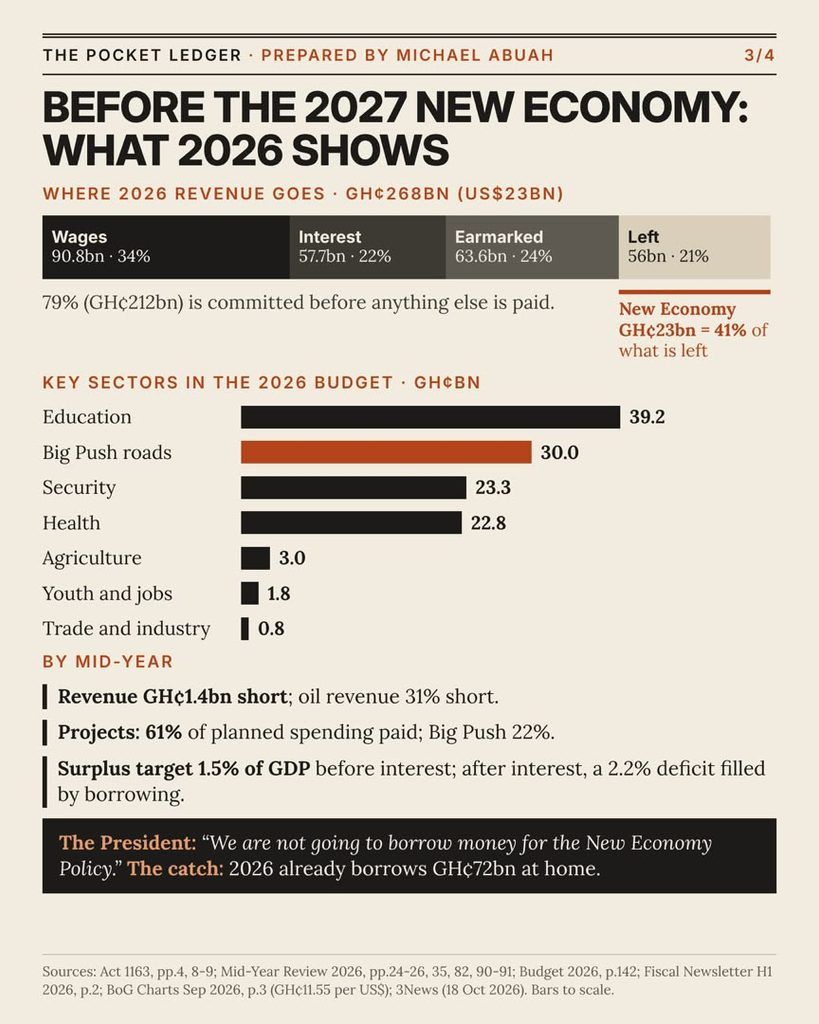
Against this backdrop, the president announced a “New Economy” initiative that will channel roughly GH¢23 bn per year—US$10 bn over five years—into job‑creating projects. The president emphasised that the policy would be funded from the country’s own resources, stating, “We are not going to borrow money for the New Economy Policy… this is our own money.”
However, the 2026 budget shows that wages, interest and earmarked funds already consume 79 % of revenue, leaving only GH¢56 bn for goods, services and projects. The 2027 projection suggests that the New Economy would account for 41 % of that remaining pool.
Questions linger about how the government will meet the funding gap. Options include tightening revenue mobilisation, raising taxes, or domestic borrowing—though the budget already plans GH¢72 bn of home borrowing. The Bank of Ghana’s September 2026 release noted a cost‑of‑borrowing reduction to 15.6 %, a 14.6‑point drop from 30.2 % in 2025.
External risks also loom. Gold, which contributes 68 % of Ghana’s exports, saw prices fall 9.1 % from March to August 2026, and the World Bank projects further declines in 2027. This volatility could erode foreign earnings and strain the fiscal position as GH¢58 bn of bonds mature in 2027, the same year the New Economy is set to launch.
For young Ghanaians, parents and business owners, the key indicators to monitor are unemployment, youth unemployment, inflation in utilities, and the government’s ability to mobilise revenue without excessive borrowing. The next few months will reveal whether the New Economy can translate its ambitious financial outlay into real job creation and sustained growth.