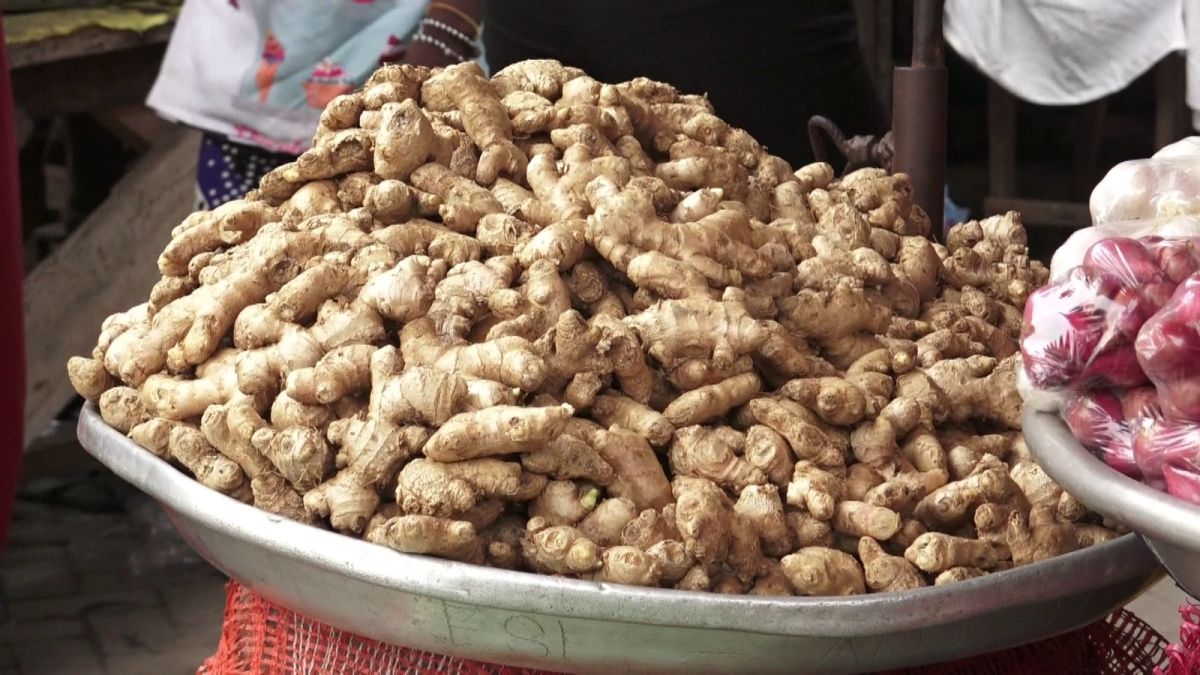
Ginger supply shortages and persistently high prices are pushing traders in Ghana to import the commodity from China and Morocco, as they urge the government to support local farmers to restore production and ease market pressures.
Traders say prices have remained elevated for nearly three years following disease outbreaks that damaged local ginger farms. Growing demand from food and beverage manufacturers, coupled with exports to neighbouring countries, has further tightened supplies.
The shortages are also affecting consumer demand, with traders reporting a decline in sales as households cut back on purchases of the spice.
Trader Akua Stella said the expanding use of ginger in drinks, toffees and biscuits, alongside exports of locally produced supplies, had contributed to rising prices. “The use of ginger in drinks, toffees and biscuits, as well as the export of locally produced ginger, has contributed to the high prices. This one I am selling is from Morocco. We sometimes buy a sack for GH¢5,000, GH¢4,500 or GH¢5,500. A bucket of ginger now sells for GH¢400, an olonka for GH¢300, while a smaller quantity costs GH¢100,” she said.
She noted that although prices had eased from a peak of GH¢8,000 per sack, they remained high and continued to strain traders and consumers. “Ginger prices have remained high over the past three years, but the situation has worsened this year. The price of a sack rose to GH¢8,000. It has now reduced,” she added.
Another trader, Nimatu Mustapha, traced the supply challenges to a virus outbreak that damaged ginger crops on local farms about two years ago. She said traders had been told that a remedy had been found, but the latest harvest had yet to reach the market, limiting the prospects of an immediate recovery in supply. “The problem started about two years ago when a virus outbreak destroyed ginger crops on local farms. We have not received reports of a similar outbreak this year, as we are told a cure has been found. However, the new ginger harvest is not yet on the market, and we do not expect prices to return to previous levels,” she said.
Mustapha also cited competition from buyers in neighbouring Togo, who she said could offer more attractive prices to Ghanaian suppliers because of differences in currency value. She explained that Togolese traders turned to Ghana for supplies last year when their own production was affected by the outbreak. Their purchasing power, she said, made it harder for local traders to compete for available stocks. “Last year, Togo was also affected by the virus outbreak, forcing traders to source ginger from Ghana. Because the CFA franc is stronger, Togolese buyers can offer better prices, leaving local traders struggling to compete,” she said.
With local supplies yet to recover sufficiently, traders say imports from China and Morocco are helping to fill the gap. Supplies from Côte d’Ivoire have also reportedly been affected by production challenges.
The growing reliance on imported ginger highlights the pressure on Ghana’s domestic supply chain, as traders seek alternative sources to meet demand while local production remains constrained.
Trader Irene Pokua said a sack of ginger now sells for between GH¢5,000 and GH¢6,000, depending on prevailing market conditions, despite falling from its previous peak of GH¢8,000. “Because ginger is expensive, consumers are no longer buying as they used to,” she said.
The decline in demand is creating an additional challenge for traders, who must contend with high procurement costs while consumers reduce the quantities they buy.
The traders are urging the government to support farmers, address the production challenges and improve the availability of locally grown ginger. Akua Stella said increased domestic production would help ease supply shortages, reduce dependence on imports and improve access to the commodity at more affordable prices. “If the government supports farmers to increase local ginger production, traders will no longer need to import the product from other countries,” she said.
A sustained recovery in local production could help stabilise market supplies. However, traders say prices are unlikely to ease significantly until fresh harvests become available in sufficient quantities.