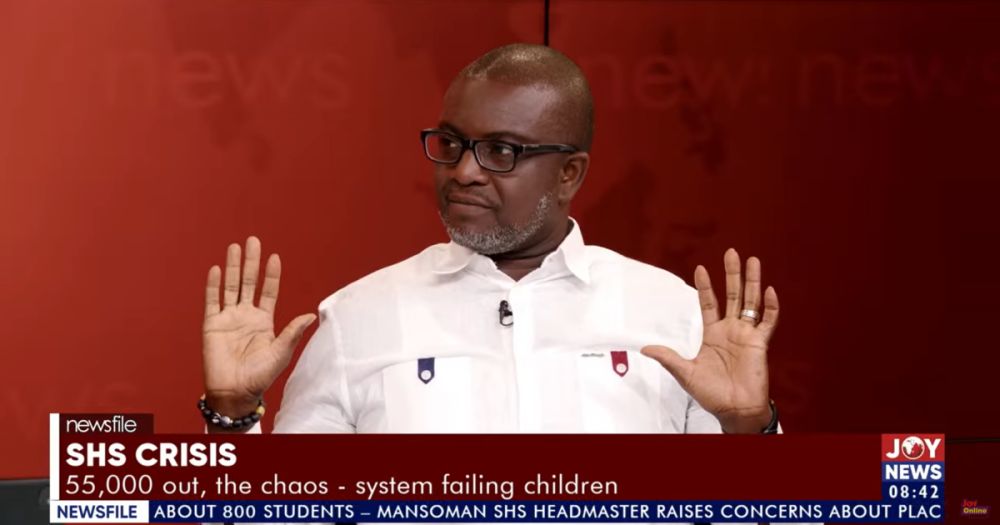
Former Deputy Director‑General of the Ghana Education Service, Dr Kwabena Bempah Tandoh, told JoyNews’ Newsfile that the turmoil surrounding the 2026 senior high school (SHS) placement exercise was largely caused by changes to the established placement model. He added that the new eligibility rules and the decision to allow students to choose two Category A schools created a mismatch between demand and capacity.
Speaking as the spokesperson for the NPP Policy Committee on Education, Dr Tandoh explained that the GES placement system had historically balanced student choice with available places. He recalled that before the 1987 reforms pupils sat the Common Entrance exam and were admitted to schools based on their preferences and capacity. The 2005 Computerised School Selection and Placement System modernised the process but did not eliminate cut‑off points, as schools could only admit students up to their available capacity.
The 2017 Free SHS policy expanded access, but students who failed both English and Mathematics were generally excluded from progression. Dr Tandoh cited 10,184 students in 2024 and 13,919 in 2025 as examples. He said the 2026 eligibility rule was changed without adequate communication, leading to an initial decision to classify 54,985 candidates as disqualified before the Ministry of Education reversed its stance 48 hours later.
Dr Tandoh disputed claims that a shortage of SHS places was the main problem, pointing to 859,828 available places against about 623,000 candidates. He noted that 1,132 infrastructure projects were undertaken between 2019 and 2025 to increase capacity. He argued that the real issue was the concentration of demand on particular schools.
The shift to allowing two Category A choices, he said, put additional pressure on the system. Category A schools had only about 76,417 places, yet roughly 313,000 students selected them. He described the change as poorly thought through and created a substantial gap between demand and capacity.
Dr Tandoh also criticized the communication that students with aggregates between six and ten could access Category A schools, which set unrealistic expectations. He emphasized that admission must balance choice with merit, using Presbyterian Boys’ Secondary School as an example where only the highest‑performing students could be admitted to a programme with limited vacancies.
He concluded that the 2026 crisis was driven by changes to the placement model, increased pressure on Category A schools and inadequate communication, rather than a lack of infrastructure. He called for greater consistency in education policy and stronger stakeholder consultation before major changes are introduced.