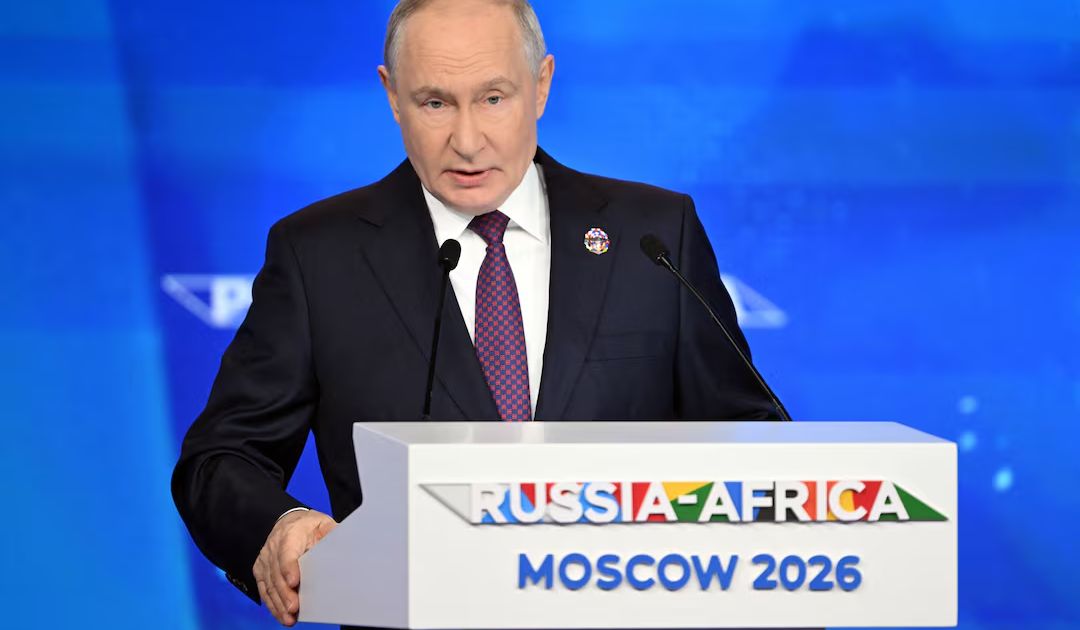
President Vladimir Putin addressed African leaders on Wednesday at the third Russia‑Africa Summit in Moscow, proclaiming Russia the continent’s best partner and accusing the so‑called colonial West of still exploiting Africa’s resources and using debt to stall development.
The two‑day event, attended by delegations from 48 African countries, saw Putin promise one‑on‑one talks with 22 African leaders on trade, security, arms and grain. He highlighted Russia’s willingness to share digital know‑how, localise production and create jobs and tax revenue, contrasting this with Western “predatory” financial terms that he said keep Africa in debt bondage.
Putin said Africa is “increasingly asserting itself as one of the key players in the global economy and politics,” but warned that a multipolar world faces resistance from “countries that are accustomed to thinking in terms of their colonial past and to enriching themselves fabulously.” He did not name specific countries but spoke of “active attempts by Western countries” to drive Africans back into debt.
In response, Burkina Faso’s Prime Minister Rimtalba Jean Emmanuel Ouedraogo said cooperation with Russia was transparent and ensured both parties’ interests, adding that Moscow was not trying to erase African languages and cultures. “This is completely different from what we had with imperialist France,” he told RT television.
Putin also announced Russia’s readiness to champion greater African influence in the IMF and World Bank, to embark on joint transport and agricultural infrastructure projects, and to supply grain and fertiliser to more African countries. Moscow’s strategy, he said, is to counterbalance Western pressure over Russia’s war in Ukraine by courting Global South leaders.
Russian paramilitary forces have been accused of supporting military juntas in Africa, such as Mali, to expand Moscow’s geopolitical influence and squeeze out former colonial powers. Moscow rejects these assertions.
As the summit concludes, observers will watch how Russia’s promises translate into concrete investment and whether African leaders will shift their alliances away from Western aid structures.