In the latest cycle of the Basic Education Certificate Examination (BECE), the Computerised School Selection and Placement System (CSSPS) recorded an automatic placement rate of 87.32%, the highest since 2021. Of the 604,567 candidates who qualified for placement in 2026, 527,932 were automatically matched to senior high schools, up from 81.96% in 2025 and well above the 66.23% recorded in 2021, the first year covered by the data.
The data also show a steady decline in the number of candidates requiring self‑placement – the fallback route for those not automatically matched. As of the close of Thursday, 10th September, only 53,887 candidates, or 8.91% of those qualified, had registered for self‑placement in 2026, down sharply from 187,542 (33.77%) in 2021. Registration for 2026 was still open at the time of this count and continued into Friday, 11th September, so the figure is expected to rise before the exercise closes.
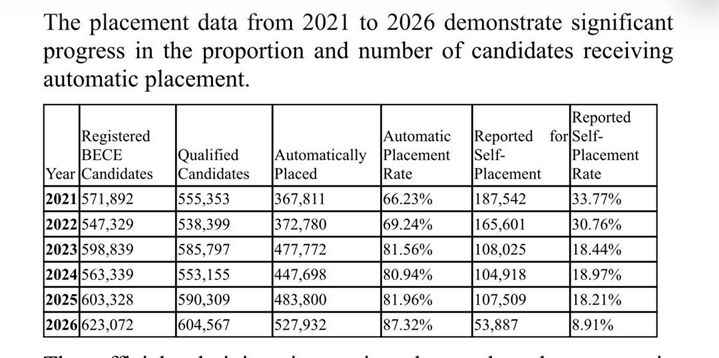
Over six placement cycles, the automatic placement rate jumped from 69.24% in 2022 to 81.56% in 2023, then held broadly steady in the 81–82% range for three years before climbing again to this year’s 87.32%. The number of candidates registering for the BECE has fluctuated only modestly, from 571,892 in 2021 to 623,072 in 2026, indicating that the gains in automatic placement reflect genuine improvements in the placement process rather than a smaller applicant pool.
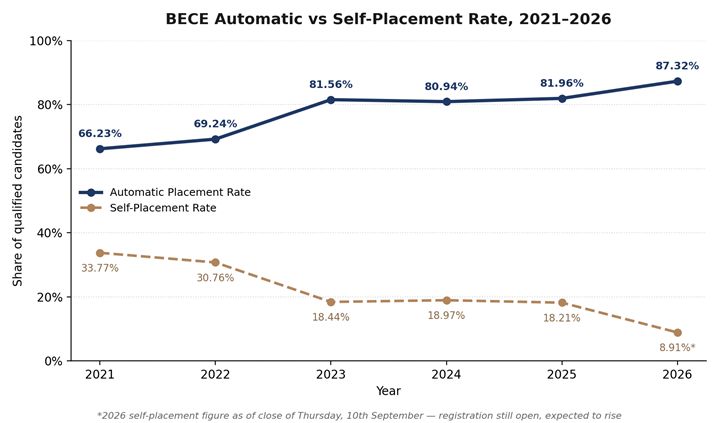
The shrinking self‑placement pool suggests the CSSPS algorithm is increasingly able to match candidates to a school of their choice without manual intervention, reducing the stress and uncertainty that families previously faced when securing a place outside the automated system. A smaller self‑placement group also means fewer families navigating a more uncertain, often more stressful process, and potentially less last‑minute congestion at placement centres in the weeks after results are released.
With self‑placement registration still running past the 10th September count used in this report, the final 2026 self‑placement figure and the small residual balance still to be accounted for are likely to move slightly before the cycle is fully closed out.