At the 81st United Nations General Assembly, Barbados Prime Minister Mia Amor Mottley urged world leaders to move from climate knowledge to action, saying the planet already knows enough to act. She warned that the world’s failure lies in converting what we know into practice and global capacity into solidarity.
President John Dramani Mahama echoed the call, declaring climate change a test of global equity. He pointed out that Africa contributes less than 4% of global greenhouse gas emissions yet bears the heaviest climate devastation, and he urged for climate finance that does not deepen debt burdens of vulnerable countries. “Mitigation support must be operationalized with predictable, non‑debt‑creating grants, not loans that further indebt fragile economies,” he said.
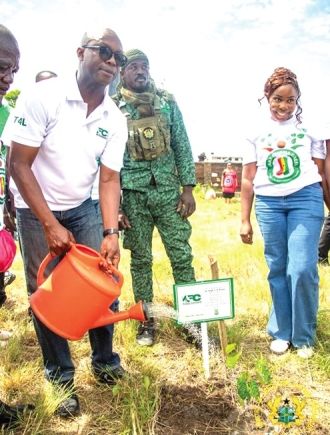
While the UN talks unfolded, more than one hundred thousand people gathered at Climate Week NYC 2026 for the Reforest the Future Summit, where the Ghanaian reforestation strategy was a focal point. The country’s 2040 reforestation plan seeks to restore degraded forests, increase tree cover and protect forest resources through coordinated national effort, with the Forestry Commission acting as the anchor institution.
Forestry Commission Chief Executive Dr. Hugh C. A. Brown explained that the proposed country‑platform model would bring partners together to share knowledge, access technical support and funding, and collaborate on the ground. The platform aims to create synergy between projects, reduce competition for limited resources, and provide a consistent framework for data, policy support and quality controls.
Forest restoration company Terraformation’s CEO Jad Daley highlighted the need for a financial architecture that matches the diversity of reforestation opportunities. He argued that a country platform can help create a financial framework that recognises projects that can be advanced through carbon markets, while others require donor or concessional funding.
Ghana’s Forestry Commission has already strengthened its carbon market work, monitoring and evaluation, positioning the country to attract more investment into restoration projects. Daley stressed that the platform’s power lies in moving from competition to collaboration, raising skill levels, resources and consistency in performance measurement, and ultimately creating a country where donors and investors can expect great outcomes.
Both Mottley and Mahama’s messages converge on the idea that the climate crisis is no longer about understanding what must be done; it is about turning knowledge into action. The country‑platform model offers a blueprint for equitable finance and collaborative reforestation that could serve as a global model.