
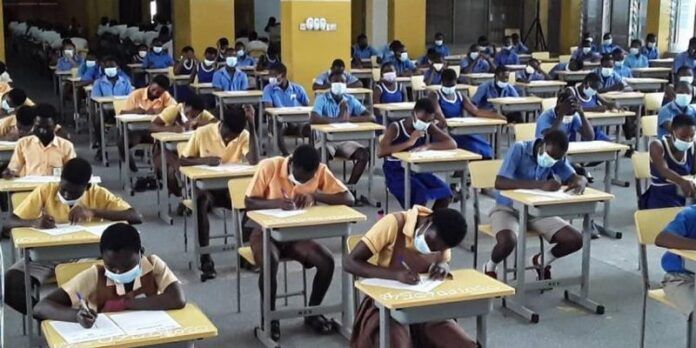
Last month the West African Examinations Council (WAEC) released the 2026 Basic Education Certificate Examination (BECE) results, revealing that more than 50,000 learners failed in English and Mathematics. The scale of the failures has sparked a national conversation about why Junior High School (JHS) students are performing so poorly.
Analysts point to a range of factors—discipline issues, phone distraction, examination malpractice, and teacher quality—but the root cause appears to lie in the knowledge base that students bring into JHS. If foundational learning is weak, the final examination will inevitably expose it.
Evidence from earlier stages of the education system underscores this point. Ghana’s 2024 National Standardised Test (NST) showed that 50 % of P4 learners were below basic proficiency in English and 45 % were below basic proficiency in Mathematics. Only 21 % reached high proficiency in English and 18 % in Mathematics. Earlier, the 2022 Primary 2 NST found that just 38 % of learners could read at grade level, while 62 % could not. In the most recent Early Grade Reading/Mathematics Assessment (EGRA/EGMA), a staggering 98 % of learners could not read at grade level.
These figures suggest that the BECE is not the starting point of Ghana’s learning crisis but its culmination. A child who cannot read fluently or comprehend a text struggles across all subjects. By the time they reach JHS, the cumulative deficit becomes apparent, and the curriculum—designed for higher complexity—offers little room for remediation.
Ghana’s 2023 Partnership Compact has identified foundational learning as a priority reform area, emphasizing literacy, numeracy and socio‑emotional skills as building blocks for later education. Yet questions remain about targets, system‑wide strategy, funding, and monitoring. Without a coherent, systems‑led approach, BECE results are unlikely to improve.
The country’s Standards‑Based Curriculum, which now includes 13 subjects at the basic level and introduces languages such as Chinese, French and Arabic from Primary 1, is ambitious. However, implementation depends on teachers, limited instructional time, finite resources and diverse learner needs. Global evidence shows that strong learning outcomes arise when systems master a few foundational skills before expanding.
NaCCA’s National Curriculum Framework acknowledges these challenges and calls for a focus on foundational literacy and numeracy. The next steps will involve aligning policy, curriculum, teacher training and resource allocation to ensure that every child enters JHS with the skills necessary to succeed.
What comes next is a national review of how foundational learning is measured, funded and integrated into the broader education system. Stakeholders are urged to move beyond paper plans and implement a clear, coherent strategy that prioritises mastery of core skills.