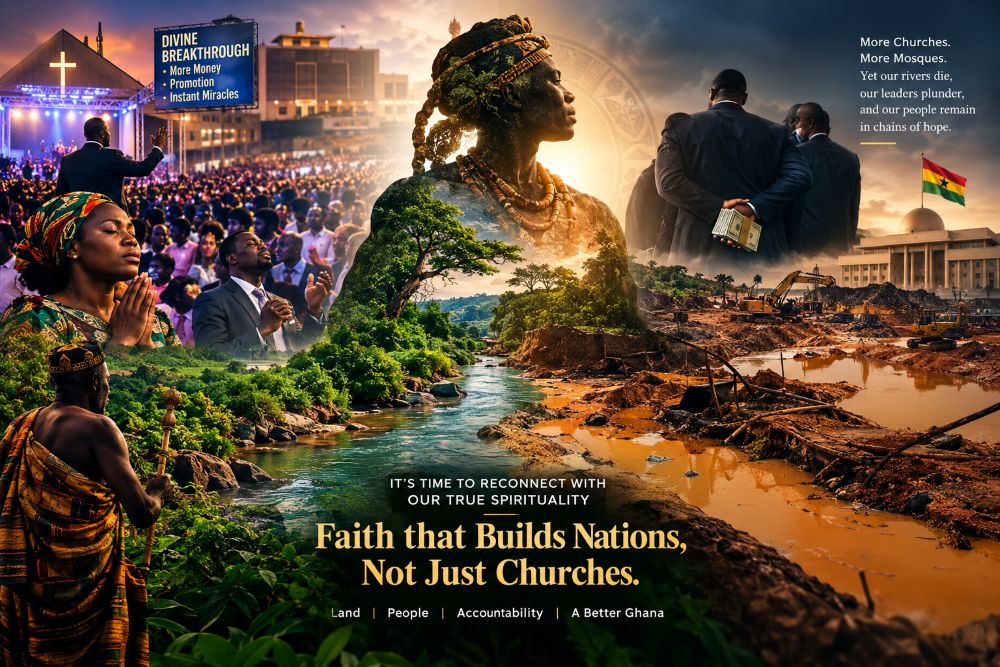
In cities, towns and villages across Ghana, Sunday and Friday mornings are saturated with religious fervour. Packed auditoriums, echoing cathedrals, overflowing mosques and all‑night prayer vigils fill the streets, while billboards tout instant financial breakthroughs and divine promotions. By most external measures, the country ranks among the world’s most religious nations.
Yet, a walk beyond the sanctuary reveals a stark contrast. The Pra, Birim and Ankobra rivers, once revered by ancestors, now run with toxic sludge from illegal mining operations. These activities often occur with the tacit approval or direct involvement of leaders who sit in the front pews of the very institutions that claim moral authority. Corruption is endemic, civic trust fractured, and the moral fabric of society appears to decay alongside the proliferation of religious buildings.
Author Ben Brako argues that Ghana’s moral paradox stems from a civilizational confusion: an indigenous, holistic spirituality of sacred accountability has been replaced by an imported, institutional religion that offers transactional escape. This shift severed the moral cord that once bound leaders, communities and the environment to a higher ethical order.
Brako distinguishes between institutional religion and African cosmology. Institutional religion is a top‑down, bureaucratic system focused on dogma, individual salvation and transactional mechanics, where divine favour is bought through financial seed‑sowing or ritual compliance. In contrast, indigenous African cosmology is an ethical, relational worldview that unites nature, community, leadership and ancestral spirits into a single moral ecosystem.
The colonial introduction of Christian and Islamic missions altered this balance. While missions provided schools and hospitals, they also displaced indigenous cultural understanding, promoting a European mindset that required the systematic unlearning of one’s own civilizational identity. Traditional healing was vilified and legally stifled, further alienating communities from their own knowledge systems.
Brako notes that the anti‑colonial struggle, though sometimes inspired by biblical concepts of justice, was mediated through Westernised frameworks. Founding fathers accepted a structural compromise, capturing the colonial administrative state rather than dismantling it. This left Ghana with a governance model that mirrors the colonial machine, perpetuating neo‑colonial stagnation.
The replacement of indigenous spirituality with transactional religion has produced three catastrophic failures in public life. First, nature is no longer seen as a sacred trust but as a commodity to be exploited, leading to environmental degradation. Second, moral accountability has been eroded, allowing corruption to flourish. Third, the disconnect between spiritual practice and civic responsibility has weakened communal bonds and civic trust.
Brako calls for a re‑embrace of indigenous cosmology, urging leaders and citizens to restore the moral ecosystem that once guided Ghana’s development. The nation’s future may depend on reconnecting its spiritual roots with its environmental and civic duties.