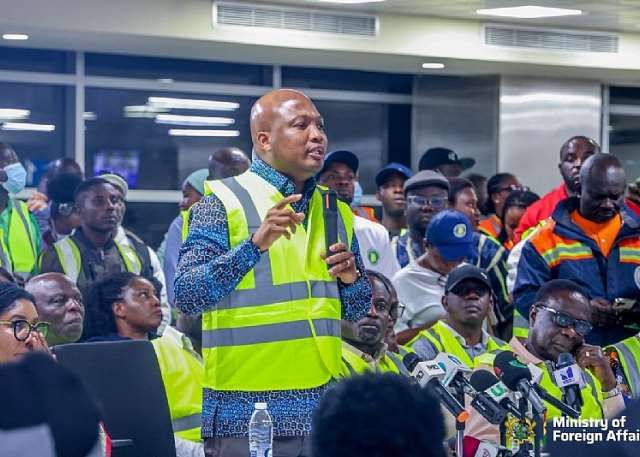
Accra will host the signing ceremony for the United Nations Convention on Negotiable Cargo Documents on 26 October 2026, a move that Ghana hopes will accelerate the digitalisation of trade paperwork and improve cross‑border transaction efficiency.
Professor Ransford Gyampo, chief executive officer of the Ghana Shippers’ Authority (GSA), said the Convention will establish a harmonised legal framework for electronic negotiable cargo documents, tackling delays, administrative costs and fraud risks that plague paper‑based trade documentation.
Speaking at a media engagement in Accra on 15 October, Professor Gyampo explained that the Convention would give electronic documents the same legal standing as their paper counterparts, provided they meet the Convention’s requirements.
“The continued dependence on paper documents can create delays, increase administrative costs, expose transactions to fraud and complicate the movement of goods across borders,” he said.
Negotiable cargo documents such as bills of lading are pivotal in international commerce, enabling cargo movement, supporting commercial transactions and forming the basis for trade finance. The Convention is expected to reduce documentation‑related delays, improve transaction efficiency and facilitate access to trade finance, while supporting more integrated digital supply chains.
Professor Gyampo stressed that the initiative goes beyond merely replacing paper with electronic records; it is about building the legal certainty and confidence needed for businesses to conduct trade in an increasingly digital environment.
“The Convention is therefore not simply about replacing paper with electronic records. It is about building the legal certainty and confidence necessary for businesses and institutions to conduct trade in an increasingly digital environment,” he said.
For Ghana, hosting the signing ceremony presents an opportunity to showcase its commitment to trade facilitation, digital transformation and stronger regional and international trade connectivity. The event aligns with Ghana’s ambition to position itself as a preferred trade and logistics hub in West Africa and to advance the objectives of the African Continental Free Trade Area (AfCFTA).
Professor Gyampo noted that a reliable legal framework for electronic negotiable cargo documents could help reduce documentary barriers, improve the flow of trade‑related information and support more efficient cargo movement across supply chains, particularly in Africa where cross‑border transactions often involve multiple jurisdictions and transport modes.
For Ghanaian importers and exporters, the expected benefits include lower administrative burdens, faster processing of trade transactions, improved opportunities for trade financing and greater predictability in international commerce.
However, Professor Gyampo cautioned that the benefits would depend on sustained efforts beyond the signing ceremony, including the Convention’s adoption, ratification and implementation, as well as the preparedness of businesses, financial institutions, transport operators and regulators to use electronic negotiable cargo documents.
“These benefits will not arise from the signing ceremony alone,” he said, calling for continued stakeholder engagement and the necessary legal, institutional, technological and commercial measures to translate the Convention’s provisions into practical outcomes.
The GSA has urged the media to raise public awareness of the Convention and explain its implications for trade competitiveness, access to finance and the digitalisation of commercial processes. The Authority reaffirmed its commitment to working with relevant ministries, the United Nations Commission on International Trade Law (UNCITRAL), industry stakeholders and international partners to promote awareness and support the Convention’s effective adoption and implementation.
The 26 October signing ceremony is expected to bring representatives of governments, international organisations and the global trading community to Accra, serving as a starting point for sustained efforts to establish a more efficient, secure and digitally enabled trading environment.