A group of friends approached a veteran investment banker to gauge whether the Dangote Petroleum Refinery IPO, priced at ₦525 per share, represented a sound investment. The banker, drawing on more than three decades in capital markets, immediately turned to the numbers, downloading the prospectus and scrutinising the refinery’s financial statements, comparable industry multiples and a discounted cash‑flow model.
What emerged was a picture of a refinery that has moved beyond the construction and commissioning phase into a profitable, high‑utilisation operation. The plant’s scale, integrated logistics and strategic position in Nigeria and the wider West African market give it a competitive edge that few African refineries possess.
However, the banker noted that the question of value is not simply whether the share price is cheap or expensive. It is about separating the underlying asset from the future cash flows that the shares represent. A great business can be an expensive investment if priced too high, and an apparently expensive share can become a bargain if the business grows beyond expectations.
The valuation debate around the refinery is wide‑ranging. Some analysts have valued the asset below the offer price, while respected Nigerian investment houses have produced figures above it. The divergence largely stems from differing assumptions about sustainable refining margins, utilisation rates, the impact of a potential second refinery, country and currency risk, and the appropriate discount rate.
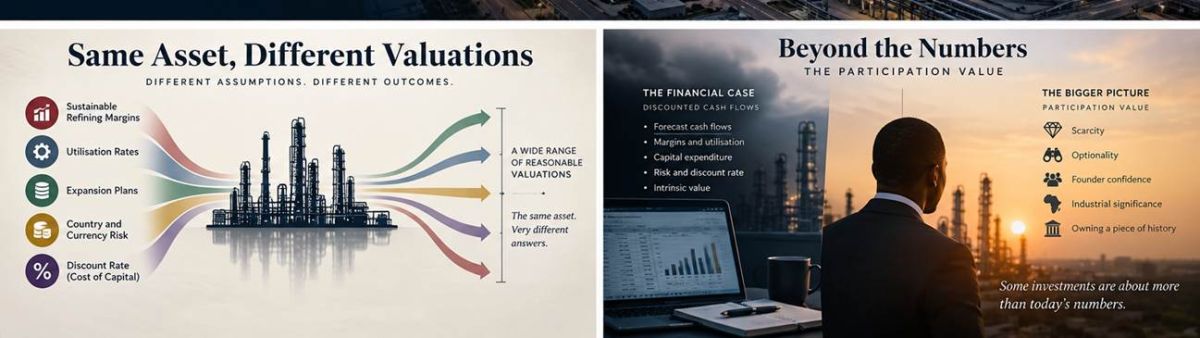
Key to the banker’s assessment were three pillars: first, the sustainability of recent high margins, which benefited from unusually favourable global refining conditions; second, the refinery’s utilisation, where fixed costs mean economics improve sharply when operating near capacity; and third, the proposed second refinery, whose value must be weighed against the capital required and execution risk.
A critical, often overlooked variable is the discount rate. Even with identical projections of barrels processed, operating margins and cash flows, analysts can arrive at vastly different valuations by applying different required returns. A lower discount rate inflates the present value of long‑term cash flows, whereas a higher rate, reflecting country risk, currency volatility, single‑asset concentration and liquidity concerns, can reduce the valuation substantially.
Ultimately, the banker emphasised that a valuation is a mathematical outcome of a set of assumptions, not a fact. Understanding those assumptions is the real work for investors considering the Dangote Refinery IPO.
As the market digests the offer, investors will need to decide whether the refinery’s unique position and growth prospects justify the share price, or whether the price reflects a premium for future optionality similar to high‑profile IPOs such as SpaceX.