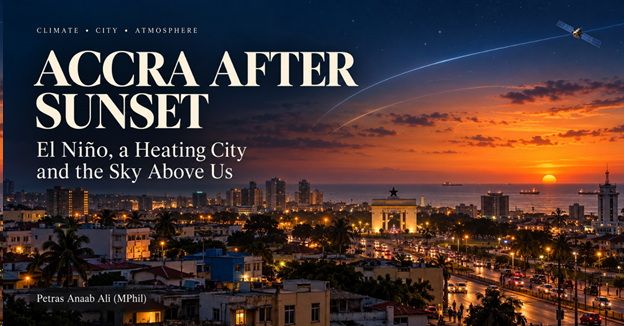
On 30 October 2026, the Ghana Meteorological Agency (GMet) issued a warning that a very strong El Niño is developing and that Ghana should prepare for a hotter, drier and dustier dry season. Heat stress is expected to peak between February and April 2027, especially in the north.
The warning follows the weekly Niño 3.4 index, the standard measure of El Niño, reaching +3.3 °C in mid‑October – a value that scientists classify as “very strong.” The US Climate Prediction Center had already put the chance at 75 % that this event would exceed every El Niño recorded since 1950.
El Niño begins with unusually warm surface water in the central and eastern equatorial Pacific. When trade winds weaken, the warm pool spreads east, heating the air above it and altering global wind and rainfall patterns through teleconnections. For Accra, the concern is how a densely built city will cope with the extra heat.
Satellite data show that Ghana and the Gulf of Guinea are about half a degree to one degree above normal in September, the second‑warmest September on record. Global temperatures usually peak a few months after El Niño peaks, so West Africa’s heat surge is still on the horizon.

Heat in Accra is not only a matter of air temperature. Dark, dense materials such as concrete and block store solar energy during the day and release it after sunset, keeping indoor spaces uncomfortable long after the sun has set. Humidity further hampers cooling, as sweat evaporates slowly in the coastal air, making a 27 °C night feel oppressive.
City authorities have begun documenting the impact of extreme heat. The AMA’s citywide Extreme Heat Perceptions Survey asks residents how heat affects their health, livelihoods, productivity, sleep, transport and daily routines. A parallel heat‑mapping exercise installed temperature sensors across the city to identify hotspots. Publishing these results will help residents understand their exposure and allow the public to judge whether interventions are needed.
While El Niño raises the odds of heat, it does not dictate the weather of every community. Ghana’s seasons also depend on the tropical Atlantic, and a cool Gulf of Guinea could shape how the 2027 rains behave. Nonetheless, the warning signals that Accra’s residents should prepare for higher temperatures, dust, and reduced rainfall in the coming months.
What to watch next: GMet will update its forecasts as the El Niño event progresses, and the AMA will release the heat‑perception survey results later this year. Residents are encouraged to stay hydrated, use ventilation, and seek shade during peak afternoon hours.