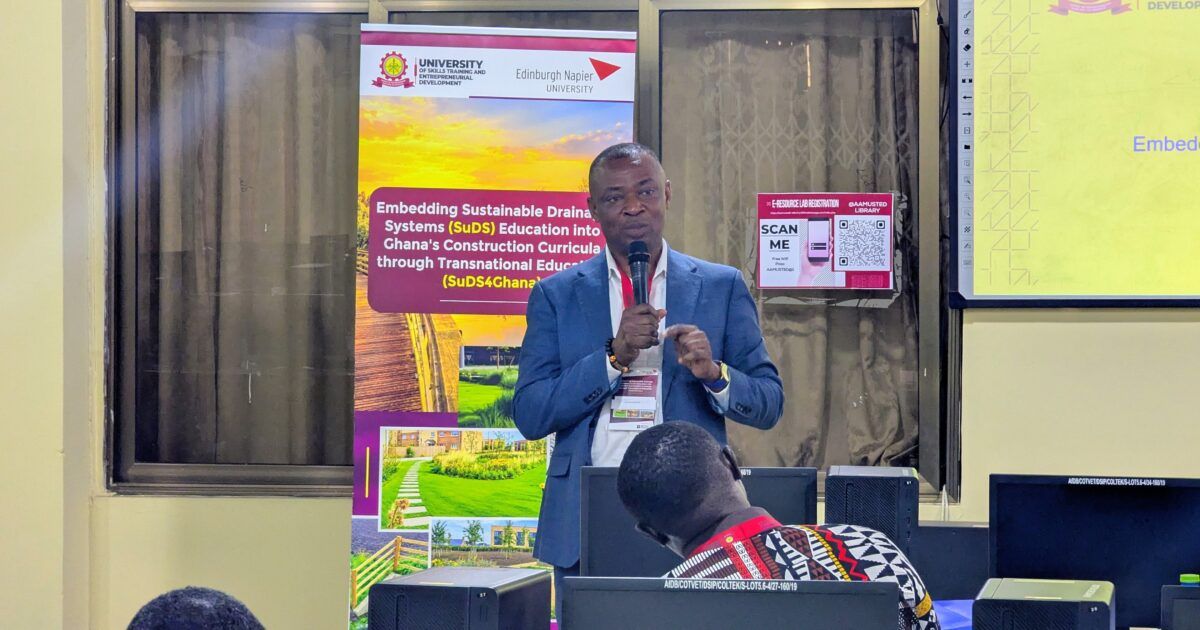
Professor Isaac Boateng, a coastal engineering and climate adaptation specialist at the University of Skills Training and Entrepreneurial Development (USTED), appealed to Ghanaian research funders at a workshop on Sustainable Drainage Systems (SuDS) in TVET and higher education institutions. He said the country needs locally generated evidence to guide engineering practice and public policy.
Boateng called on the Ghana Research Fund to consider investing in sustainable drainage system research and added that the British Council could provide additional funding to address the identified gaps. He warned that adopting designs without adapting them to local realities – such as Ghana’s rainfall patterns, soil conditions, available materials, land constraints, maintenance capacity and financial circumstances – would undermine success.
"Successful knowledge transfer does not mean copying designs without considering local realities," Boateng said, citing the need for field monitoring, student research and interdisciplinary collaboration. The workshop highlighted flooding and stormwater management challenges in Ghanaian communities, noting rapid urbanisation, changing rainfall patterns, expanding impermeable surfaces, blocked drains and encroachment on waterways as key contributors.
Boateng advocated treating stormwater as a resource rather than waste, promoting SuDS approaches such as rain gardens, permeable pavements, vegetated swales, green roofs and rainwater harvesting. He urged that these solutions complement conventional drainage and be selected according to local site conditions. He also called for SuDS concepts to be integrated into existing engineering, construction, environmental management and urban planning courses, with practical learning opportunities for students.
Associate Professor Cletus Moobela of Edinburgh Napier University, project lead, said the initiative aims to adapt international knowledge to Ghanaian conditions. “Our aim is to take solutions developed and applied globally and adapt them to the Ghanaian context,” he said. The project focuses on education and curriculum development rather than installing drainage systems at individual sites, working with instructors and institutions to embed SuDS into teaching.
Afia Yeboah Agyeman, Higher Education Project Manager at the British Council in Ghana, thanked USTED and Edinburgh Napier for the partnership. She said drainage problems are a major concern in Ghana and hoped the project would attract more partnerships and funding to expand SuDS across other higher education institutions. The initiative forms part of the British Council’s work to facilitate transnational education partnerships between Ghanaian institutions and UK universities.
Boateng concluded that the drains we design today will influence the safety of our communities tomorrow, and that the skills taught now will shape the infrastructure of the next generation.