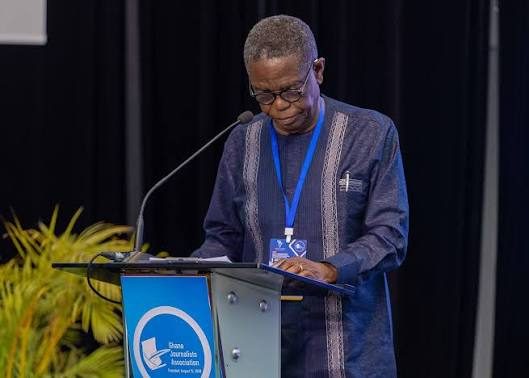
Veteran media practitioner and Managing Editor of The Insight, Kwesi Pratt Jnr, has urged media organisations and journalists not to reduce journalism to a contest for attention, saying the duty of journalists is to establish what the public needs to know.
Speaking at the 77th anniversary symposium of the Ghana Journalists Association (GJA) in Accra last Wednesday, Pratt, who is also the founder of Pan African Television, said journalism must be guided by professional judgement in an age where digital platforms often reward attention through controversy, outrage and sensationalism. "The journalist's task, however, is not simply to maximise attention, but to determine what the public needs to know," he said.
He stressed that speed should not override accuracy in the digital era, noting that being first to publish does not guarantee impact. "A journalist could be the first to publish a story and still be wrong, while another journalist could publish later and produce the most important story of the day. The internet rewards speech. Journalism requires judgment," he said.
Pratt urged media organisations to uphold the professional benchmarks that distinguish journalism from general online content and to resist pressures from digital immediacy that compromise those standards. He said the central challenge for contemporary journalism has shifted from access to information to the verification of truth within an oversaturated information environment, arguing that media credibility rests on five pillars: accuracy, verification, fairness, courage and investigative scrutiny of influential people and institutions.
The symposium, themed "GJA at 77: Building on our legacy, advancing ethical journalism and shaping the future of digital media," drew several high profile speakers, including the Chairperson of the National Media Commission, Professor Akua Opokua Britwum; the Director-General of the National Communications Authority, Rev Edmund Yirenkyi Fianko; and the UNESCO Representative to Ghana, Edmond Moukala, along with a panel discussion.
Reflecting on the profession's history, Pratt said Ghana's journalism tradition is deeply rooted in the country's political and democratic development, noting that the press has historically played a significant role in shaping public consciousness. He traced the GJA back to its founding on August 15, 1949, as the Africa Press Association, at a time when the Gold Coast was undergoing significant political transformation, and said the press was never merely an observer of that history but an active participant in the country's struggle for self-determination. "History matters, and it reminds us that journalism in Ghana did not begin as a profession concerned only with reporting what happened yesterday," he said.
He said preserving that legacy requires journalists to continually examine whether the profession is adequately serving its democratic, social and national responsibilities, and pointed to the 1992 Constitution, which guarantees media freedom and independence while also assigning it the responsibility of holding government accountable to the people. "Press freedom without responsibility can become reckless, and responsibility without freedom can become submission," he cautioned.
Pratt also interrogated the impact of ownership, financing, advertising and political affiliations on editorial autonomy, arguing that the absence of state censorship does not equate to freedom from external pressure. He said media houses cannot demand fearless journalism from journalists while ignoring the economic and professional conditions under which they work.
He criticised some TV stations for demanding a minimum number of Facebook followers from prospective presenters before offering them jobs, describing the practice as a complete affront to journalism as a profession. "I know some television stations you don't get employed as a presenter if you don't have a certain number of followers on Facebook. That is a complete affront to all of our standards and they should bow their heads in shame. They are contributing significantly to undermining our credibility," he said.
Pratt also urged Ghanaian media institutions to reassess representation in national news coverage, observing that coverage disproportionately features state officials, corporate executives and other institutional authorities, while farmers, market women, fishermen, educators, health workers, unemployed young people and entire communities receive inadequate and episodic attention. He said the inclusion of ordinary citizens in the news should not be limited to moments of disaster. "These people are not merely background scenario to the national story. They hold the country in place," he said, urging journalists to recover "the responsibility to listen and not only the ability to speak" and to pay greater attention to citizens who don't hold press conferences. "If journalism is serious about telling the people's story, it must go where the people are," he stressed.
The GJA President, Albert Kwabena Dwumfour, called for mutual commitment between journalists and the association's leadership to jointly uphold the standards that sustain media credibility. He said the GJA must be a source of professional development, guidance and protection for journalists, but that this responsibility "must work both ways." "A journalist should be able to look to the GJA for professional development, guidance when new challenges emerge, and support when the legitimate work of journalism is threatened. But the association cannot defend the credibility of journalism if journalists themselves are unwilling to uphold the standards that make that credibility possible," he said.
Dwumfour said the GJA leadership is "custodian, not owner" of the institution and has a duty to strengthen it for the next generation. He said that for 77 years the association has defended press freedom, advocated for journalists to work without fear or intimidation, and organised training to improve capacity across the country, and urged members to embrace ethics as the association navigates the challenges posed by digital media and artificial intelligence. He also paid tribute to past executives and acknowledged current national and regional executives for their work.