
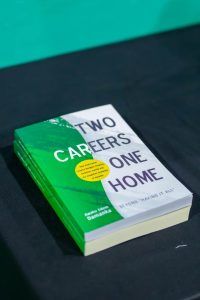
On Sunday, 8 November 2026, Kwaku Edem Damanka unveiled his latest book, Two Careers, One Home: Beyond Having It All, at a launch that drew a panel of distinguished personalities. The event offered a chance to explore the book’s central thesis: that professional achievement and a fulfilling family life need not compete, but require deliberate choices, honest conversation and shared responsibility.
Damanka draws on a 2025 survey, “Can Women and Men Have It All?”, conducted with IntegrityWorld. The 157 responses, 144 of them from Ghana, revealed that 78.7 % feel societal pressure on women to prioritize family, while 60 % feel similar pressure on men to prioritize career. The author cautions that the sample is predominantly Ghanaian and female, making the findings exploratory rather than representative.
A key contribution of the book is its Co‑Leadership framework, which encourages couples to develop a shared family vision, agree on responsibilities and hold each other mutually accountable. The framework recognises that leadership in a home should not be a contest for authority, and that partners may lead in different areas at different times based on strengths and circumstances.
Damanka also tackles the “mental load” of running a household, emphasising that invisible tasks such as planning and coordinating deserve visibility and fair discussion. He warns that governance language must be applied sensitively, as a marriage is not a management contract.
The chapter on “Career Peak Collision” presents two models for handling simultaneous career opportunities: a Turn‑Taking Model and a Double‑Primary Model. Both aim to prompt couples to discuss implications before resentment or crisis arises.
Financial partnership is addressed through a Financial Co‑Leader Model, including a Proportional Equity Framework and the use of joint and individual accounts. The model stresses transparency and shared understanding of fairness, recognising that income and obligations may differ.
Damanka concludes by extending the conversation to parenting and legacy, noting that children learn responsibility and gender roles not only from what parents say but also from what they practice at home.
Readers can anticipate further discussion on how couples can adapt arrangements as children grow and careers evolve, ensuring that sacrifices are recognised, discussed and shared fairly.