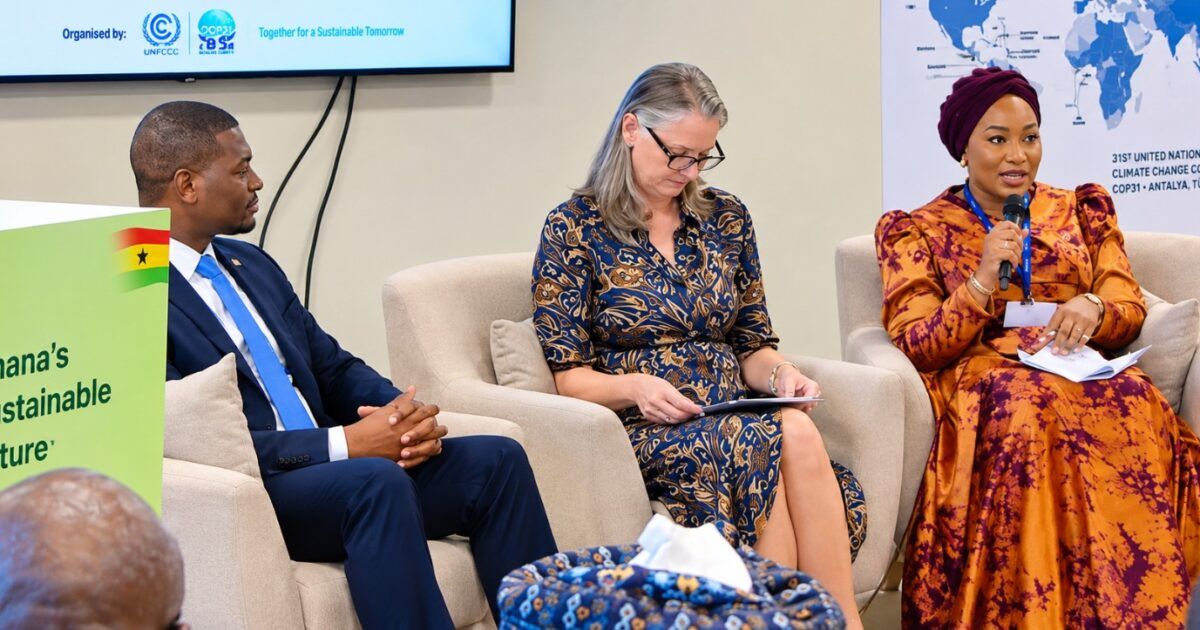
At the 31st United Nations Climate Change Conference (COP31) in Antalya, Türkiye, former Second Lady Hajia Samira Bawumia called on African leaders, development partners and the private sector to earmark roughly US$4 billion per year to speed up the continent’s shift from firewood and other traditional fuels to cleaner cooking solutions by 2030.
She warned that the continued dependence on wood for cooking is a major driver of health risks, deforestation and gender inequality. “Women and girls spend about 80 hours a week cooking,” Bawumia said, adding that this time could be better used for education and economic activities.
According to estimates from the International Energy Agency, the $4 billion figure would be needed to meet the scale of the transition. Without sustained financing and stronger political commitment, millions of households will keep relying on traditional methods, Bawumia warned, with dire consequences for public health, livelihoods and natural resources.
Highlighting Ghana’s progress, Bawumia noted the country’s National Clean Cooking Strategy, the distribution of three million improved cookstoves, and the Woodlots for Households programme run by the Council for Scientific and Industrial Research, which has already reached about 1,000 households. She also praised the Energy Commission’s partnership with the Ghana Education Service to embed clean cooking into school curricula.
She stressed that clean cooking is not only an environmental intervention but also a tool for gender equality, economic empowerment and reduced unpaid domestic work. “Anytime you talk about food systems, you have to talk about cooking,” she said. “Anytime you talk about energy transition, you have to talk about clean cooking.”
Bawumia called for deeper cross‑sector coordination, arguing that the issue cuts across health, environment, education, energy and land management, and cannot be left to a single institution. She urged governments, development organisations and private investors to deepen partnerships, mobilise funding and expand public education to make cleaner cooking technologies affordable and accessible.
She expressed optimism that sustained investment and coordinated action would accelerate Africa’s transition away from traditional cooking fuels, improving public health, supporting women’s economic empowerment and protecting natural resources.