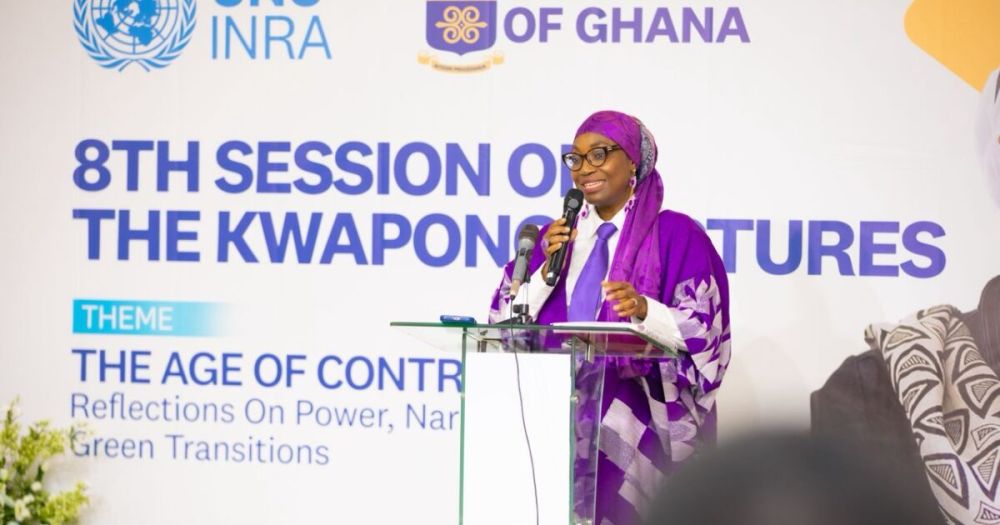
Professor Fatima Denton, Director of the United Nations University Institute for Natural Resources in Africa (UNU‑INRA), warned that Africa’s green transition cannot simply mirror global narratives. Speaking at the 8th Kwapong Lecture Series in Accra, she argued that the continent must expand energy access, create jobs and drive economic growth while responding to the push for decarbonisation.
Denton highlighted that about 600 million Africans still lack electricity, making a net‑zero focus unrealistic without addressing basic needs. She called for a long‑term transformation that recognises Africa’s natural resources as drivers of inclusive growth rather than sidelining them to fit external agendas.
She questioned the assumption that African countries can leapfrog traditional development stages through new technologies alone. “Leapfrogging is good, but do we have the space to land comfortably?” she asked, stressing that robust institutions, sound economic systems and strong social foundations are essential for technology to deliver tangible benefits.
Critics of the global low‑carbon push point to continued oil and gas demand in industrialised economies and the persistent energy poverty across Africa. Denton cited Mozambique’s natural gas and liquefied natural gas projects as examples of the difficult choices African nations face when balancing development and decarbonisation.
The professor also challenged the portrayal of critical minerals and green hydrogen as unequivocally green, noting the environmental and social costs of extraction and the heavy water demands of green hydrogen production. She warned that climate finance could deepen fiscal vulnerabilities if not managed carefully and that carbon markets are shaped by politics as much as market forces.
“Who defines what constitutes a transition? Whose terms are being used?” Denton asked, urging African leaders to adopt a deliberate, strategic approach that learns from China’s manufacturing experience and involves the private sector and local communities in a whole‑of‑society effort.
The Kwapong Lecture Series, co‑hosted by UNU‑INRA and the University of Ghana, brings scholars and practitioners together to discuss natural resource governance and sustainable development in Africa.