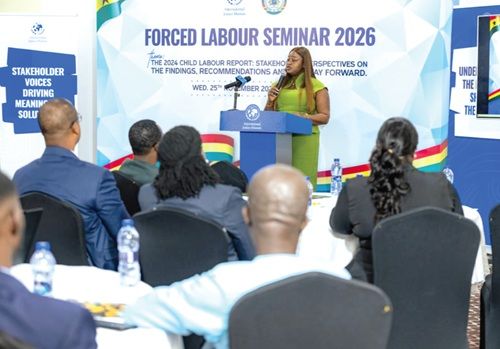
The Ministry of Labour, Jobs and Employment urged institutions and development partners to improve reporting and data sharing at a stakeholders’ forum in Accra. The aim is to strengthen national coordination, policy formulation and accountability in the fight against child labour.
Director of the Child Labour Unit, Esther Ofori Agyemang, said accurate and timely reporting is essential for identifying vulnerable communities, directing resources and assessing the effectiveness of interventions to eliminate child labour. She called for a more comprehensive national approach, warning that focusing only on the cocoa sector could mask problems in illegal small‑scale mining, domestic work and commercial sexual exploitation.
Ms Agyemang noted that while data collection for the 2025 report is complete, the final document will be shared with stakeholders later this year. She urged implementing agencies to integrate child labour interventions into their budgets and activities, citing inadequate resources, limited institutional understanding and poor reporting as major implementation challenges.
Consultant Emmanuel Antwi Boasiako presented the 2024 Child Labour Report, noting a 49 per cent drop in children identified engaging in labour, from over 27,000 in 2023 to about 14,000 in 2024. However, only 40 per cent of male and 35 per cent of female children at risk received necessary support. He highlighted a decline in economic assistance, with income‑generating activities falling from 3,700 beneficiaries in 2023 to 1,001 in 2024, and cash transfers dropping to zero.
Mr Boasiako warned that only three of 54 activities under the five‑year strategic plan were fully completed, 63 per cent were ongoing and 31 per cent had not been implemented. He called for increased funding, stronger community child protection structures, improved coordination and vocational training for children aged 15 to 17.
International Justice Mission Ghana’s Director of Justice Projects, Anita Budu, urged stronger support for state institutions such as the Department of Social Welfare, the Ghana Police Service and the Judiciary. She cautioned against parallel structures and stressed the need to address all forms of exploitative work that threaten children’s health, education and development, as outlined in Section 87 of the Children’s Act, 1998.
Ms Budu emphasized that the report should be produced annually and its findings widely disseminated to translate information into practical action. She noted that while capacity building and awareness creation have improved, significant gaps remain in identifying and remediating children in the worst forms of child labour.
Moving forward, the Ministry plans to make the annual review of child labour reports a regular exercise to enable stakeholders to assess progress, identify gaps and determine necessary interventions across all sectors.