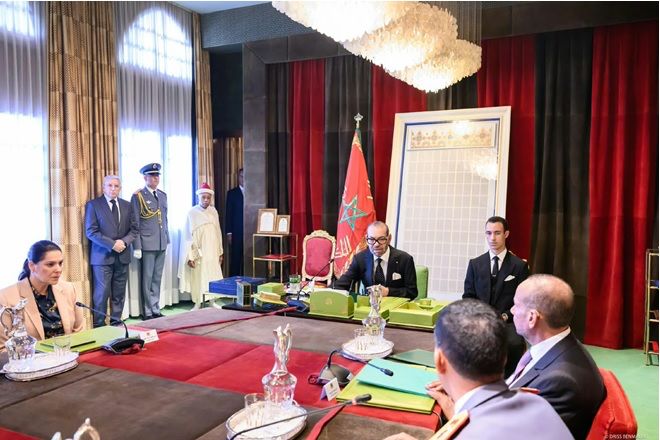
King Mohammed VI, with Crown Prince Moulay El Hassan, opened a working session at the Royal Palace in Rabat on 18 November to unveil the “Morocco Offer,” a defence industry roadmap that seeks to create roughly 50,000 direct and indirect jobs by 2035. The strategy is designed to meet about 40% of the Royal Armed Forces’ and security agencies’ equipment requirements while pushing exports to account for more than 65% of the sector’s turnover.
The plan calls for an integrated industry covering research, design, manufacturing, maintenance, testing and storage, drawing on expertise from Morocco’s aerospace, automotive and electronics sectors. Four institutional and industrial measures will underpin the programme: a dedicated strategic agency to coordinate the national defence industry strategy; an industrial holding company as the state’s investment arm; a specialised academy to support training, research and innovation; and the establishment of two new industrial acceleration zones in Ben Guerir and Benslimane, in addition to those already in Sidi Yahya and Nouaceur.
Building on the legal framework set by Law No. 10.20 in 2020, the roadmap includes projects such as the manufacturing of WHAP 8×8 armoured vehicles in Berrechid, 30 mm gun turrets at Midparc in Nouaceur, medium‑ and large‑calibre ammunition in Sidi Yahya, military drone production and maintenance in Benslimane, and autonomous systems and counter‑drone technologies. Priorities focus on drones, autonomous systems, land and naval systems, defence electronics, cyber defence and artificial intelligence.
Training will be central, with the proposed academy working with industrial operators, civilian and military professionals and Moroccan specialists abroad to develop local expertise. The strategy also aims to identify young talent and strengthen vocational training to supply the industry with qualified workers. Morocco plans to use international partnerships to expand access to global supply chains and export markets, while encouraging private investment and supporting domestic companies to compete internationally.
At the session’s close, King Mohammed VI called for rapid implementation, instructing the establishment of governance bodies, a financing plan, simplified investment procedures and increased participation by the national private sector.