Ghana’s reputation as a beacon of constitutional democracy is challenged by a deeper inquiry into the nation’s origins. The current state, formed in 1957 from the Gold Coast Colony, Ashanti territory, Northern Territories and British Togoland, was not a product of a voluntary union of self‑governing peoples but a colonial administrative amalgam. The question is whether the people ever consented to this container of sovereignty.
Historically, the land now called Ghana was home to mature, autonomous societies: the Asante, Dagbon, Fante, Ga‑Adangbe and Ewe, each governed by stool, skin or Tendamba institutions that were accountable, consensual and rooted in the community. These entities were brought together by imperial convenience for administration and extraction, not by treaty or mutual agreement. When the Crown’s 1894–1897 Lands Bills threatened to vest all “unoccupied” land in the British Crown, the Aborigines’ Rights Protection Society (ARPS), led by Jacob Wilson Sey and backed by intellectuals such as John Mensah Sarbah and J. E. Casely Hayford, successfully defended native law in London.
That victory demonstrated that chiefs and scholars could unite to protect national interest. The later rupture, when the educated class distanced itself from traditional authority, is seen as a betrayal that weakened the nation. In 1957, the new government transferred the colonial centralised machinery to its own leadership instead of dismantling it, preserving the tools of control rather than restoring authority to the traditional councils that had been stripped of power.
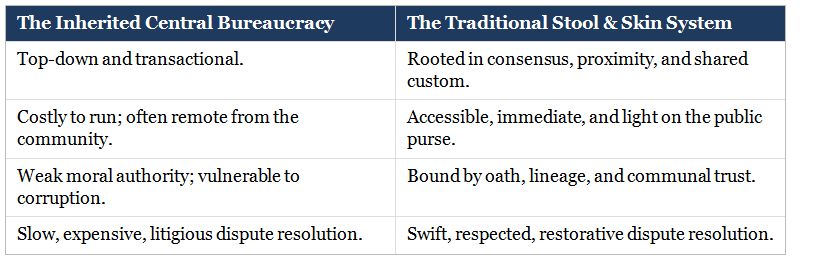
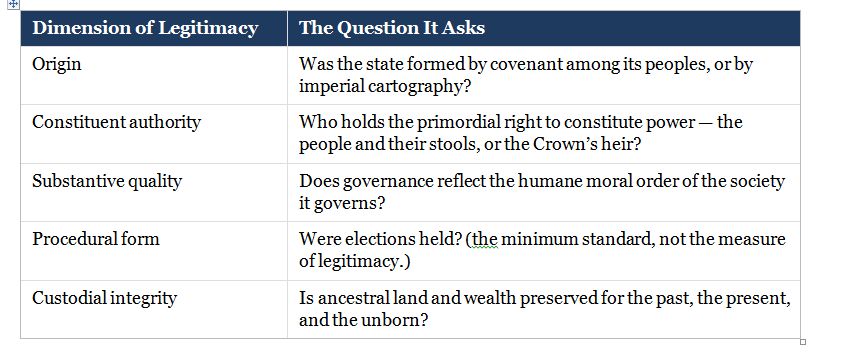
Today, Ghana’s constitutional order is judged against a standard that values consent, custodianship and consensus rather than mere procedural legitimacy. The debate centers on whether the state’s foundation rests on the covenantal trust of ancestors, living communities and unborn generations, or merely on inherited bureaucracy.
Moving forward, scholars and policymakers argue for an evolution of institutions—strengthening the House of Chiefs, the Council of State and traditional consensus mechanisms—to align the constitution with the people’s consent and custodial responsibilities. The outcome will shape Ghana’s democratic identity and its relationship with its diverse cultural heritage.